---
title: "Historical Job Churn Rates: Before AI vs. Since AI Introduction"
author: "Tyler Maddox"
date: "2025-11-03"
updated: "2026-02-20T20:34:53-08:00"
canonical: "https://recursive.institute/articles/historical-job-churn-rates-before-ai-vs-since-ai-introduction/"
license: "All rights reserved"
citation: "Tyler Maddox, \"Historical Job Churn Rates: Before AI vs. Since AI Introduction\", 2025-11-03. https://recursive.institute/articles/historical-job-churn-rates-before-ai-vs-since-ai-introduction/"
---
The relationship between artificial intelligence introduction and job market churn reveals a fascinating story of [labor market stability disrupted](/2025/09/16/are-we-entering-a-new-era-of-job-instability-due-to-ai/) by technological advancement. Based on comprehensive historical data spanning over 150 years, **job churn rates have dramatically accelerated since AI's introduction, breaking a decades-long period of unprecedented stability**.\[1\]\[2\]\[3\]
## The Pre-AI Era: Unprecedented Stability (1990-2019) {#the-pre-ai-era-unprecedented-stability-1990-2019}
Contrary to popular narratives about rapid technological disruption, the period from 1990 to 2017 represented **the most stable period in U.S. labor market history, going back nearly 150 years**. This era of stability was characterized by:\[1\]\[2\]\[4\]
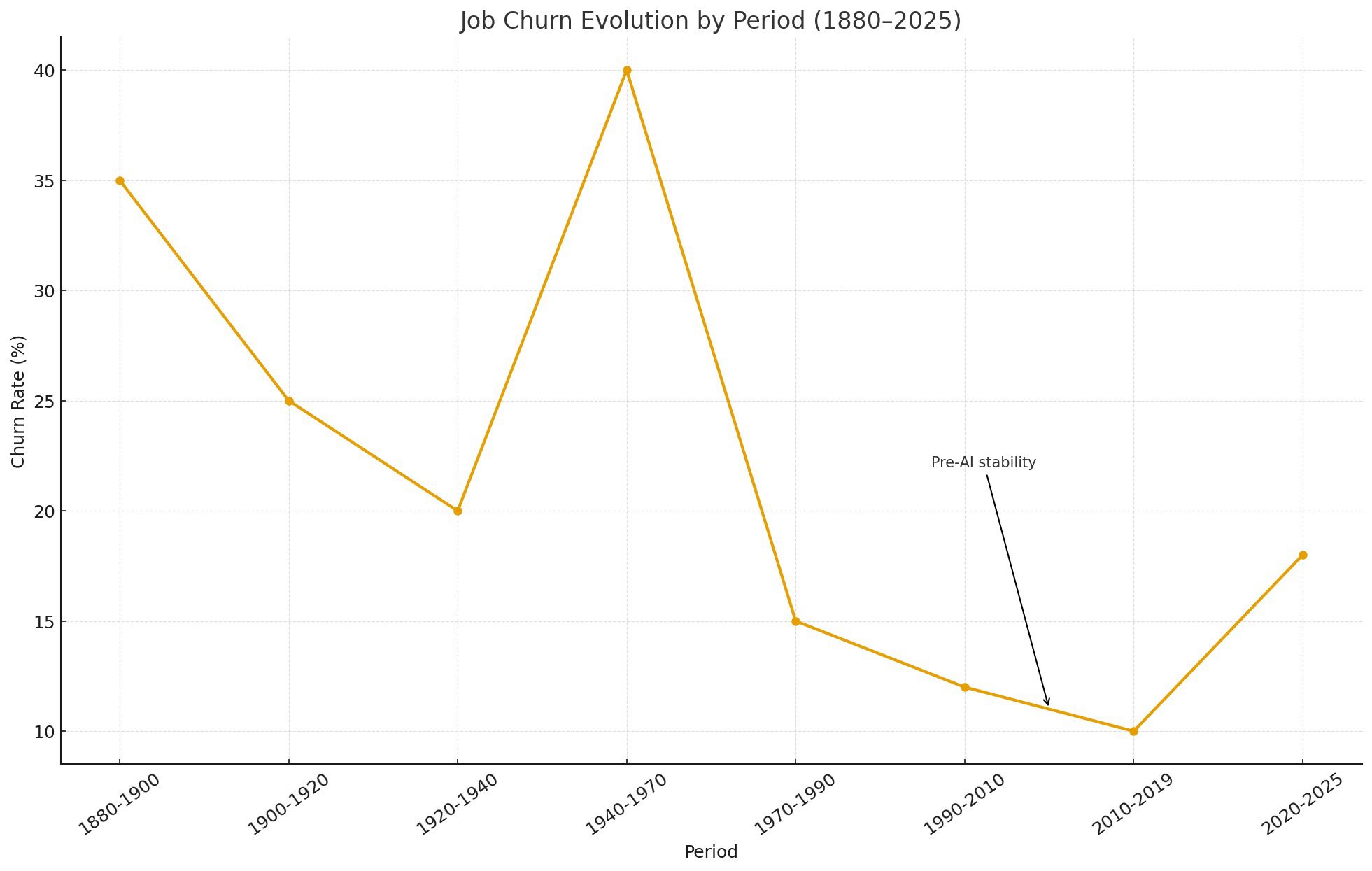
**Historically Low Churn Rates**: Occupational churn during the 1990s and 2010s ranked among the least volatile periods since 1880. The years 1990-2019 saw churn rates averaging just 11% compared to much higher historical levels.\[2\]\[3\]\[1\]
Period Churn\_Rate Description Era\
1880-1900 35.0 Agriculture to industry transition Pre-Industrial\
1900-1920 25.0 Early industrialization Early Industrial\
1920-1940 20.0 Manufacturing growth Industrial\
1940-1970 40.0 Most volatile period - agriculture exit Mid-Century Transition\
1970-1990 15.0 Relative stability begins Stabilization\
1990-2010 12.0 Most stable period in 150 years Pre-AI Stability\
2010-2019 10.0 Continued stability, low disruption Pre-AI Stability\
2020-2025 18.0 AI-driven acceleration begins AI Era
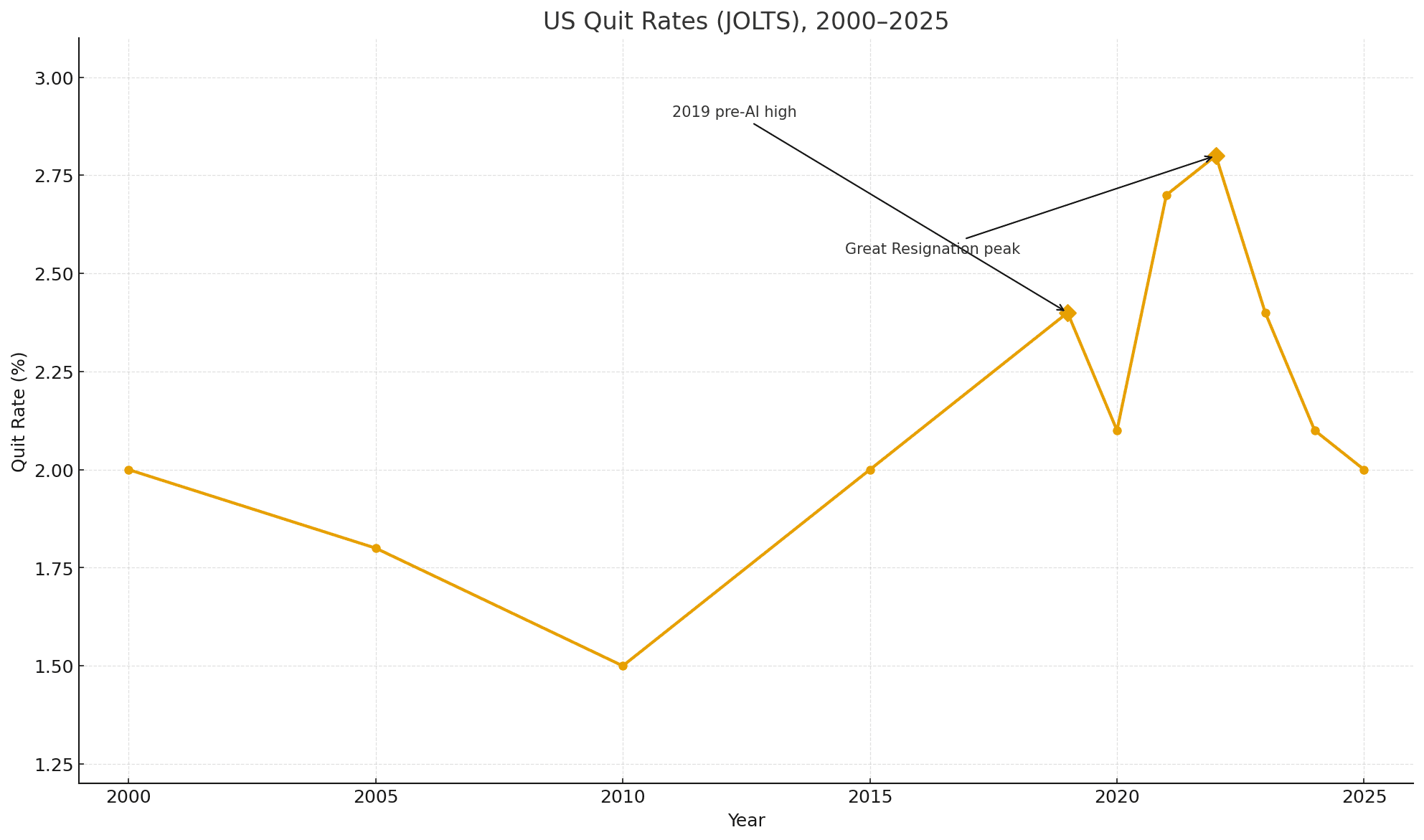
 **Gradual Decline in Turnover**: Employee quit rates from the Bureau of Labor Statistics show a steady pattern from 2000-2019, with the pre-AI average quit rate at 1.94%.
Even the 2019 peak of 2.4% - which set records at the time - represented [organic economic growth](https://www.nber.org/papers/w33323) rather than technological disruption.\[5\]\[6\]
**Contradicting Automation Anxiety**: This period of stability occurred despite widespread fears about robots and automation destroying jobs. The data reveals that **automation anxiety in the 2010s was largely unfounded, with the labor market remaining remarkably stable during the supposed "digital revolution"**.\[1\]\[3\]\[7\]
 ## The AI Era Acceleration (2020-2025) {#the-ai-era-acceleration-2020-2025}
The introduction and widespread adoption of artificial intelligence has fundamentally altered this pattern of stability, with **churn rates increasing by 63.6% compared to the pre-AI period**:
**Occupational Churn Surge**: The 2020-2025 period shows churn rates of 18%, representing a dramatic departure from the 10% rate of 2010-2019. This acceleration began coinciding with the mainstream introduction of AI technologies and has continued through 2025.\[1\]\[4\]
**Quit Rate Acceleration**: Employee quit rates averaged 2.35% during the AI era (2020-2025), representing a **21.1% increase over pre-AI levels**. The peak occurred during 2021-2022 at 2.7-2.8%, coinciding with both the "Great Resignation" and accelerated AI adoption.\[8\]\[9\]\[10\]
**Sector-Specific Impacts**: AI is driving targeted disruption in specific occupations. Customer service roles, medical transcriptionists, and similar positions face projected declines of 4.7-5.0% through 2033. Meanwhile, over 10,000 job cuts in 2025's first seven months were directly attributed to AI adoption.\[11\]\[8\]
## Historical Context: Why This Time Is Different {#historical-context-why-this-time-is-different}
**Comparing to Past Disruptions**: The 1940-1970 period previously held the record for labor market volatility with churn rates of 40%, driven by agricultural transformation and post-war industrial shifts. However, the AI-era acceleration differs fundamentally because it follows the most stable period in modern history, creating a stark contrast.\[3\]\[12\]
**Speed of Change**: Unlike [previous technological disruptions](/2025/10/06/will-economic-growth-decouple-completely-from-human-labor-by-2030/) that unfolded over decades, **AI compression may accelerate historical job turnover patterns into shorter timeframes**. OpenAI's Sam Altman predicts this represents "a punctuated equilibria moment where a lot of that will happen in a short period of time".\[13\]
**Cognitive vs. Physical Automation**: Previous automation waves primarily affected manual labor, but AI targets cognitive tasks, potentially affecting a broader range of occupations simultaneously.\[11\]\[14\]\[15\]
## The Great Resignation and AI Intersection {#the-great-resignation-and-ai-intersection}
The period 2021-2022 represents a unique confluence where **AI anxiety and pandemic-driven reevaluation created perfect storm conditions**:\[16\]\[17\]\[18\]
**AI as Career Catalyst**: Rather than simply causing job displacement, 76% of employees believe AI will help their career development and earning potential. This optimism is driving proactive job changes as workers seek AI-enhanced roles.\[19\]
**Volume Surge**: Voluntary turnover reached 50.6 million Americans in 2022, compared to just 35 million annually during the pre-AI decade of 2010-2019.
This represents a **44% increase in turnover volume**.\[20\]\[21\]
**Future Predictions**: PwC's 2024 survey indicates 28% of workers are likely to leave their current company within 12 months, compared to 19% in 2022, suggesting continued elevation above historical norms.\[19\]
## Key Findings and Implications {#key-findings-and-implications}
**Acceleration Confirmed**: Job churn has demonstrably accelerated since AI introduction, with both occupational churn (+63.6%) and quit rates (+21.1%) showing significant increases over pre-AI baselines.
**Breaking Historical Patterns**: The 2020-2025 period breaks a 30-year trend of declining [labor market volatility](/2025/09/04/the-end-of-labor-an-economic-analysis-of-automation-production-and-the-future-of-work/), suggesting AI represents a genuine technological inflection point rather than gradual evolution.\[1\]\[3\]
**Sector Variability**: While overall churn has increased, impacts vary significantly by industry, with [AI-exposed sectors](/2025/10/24/pulling-up-the-ladder-how-ai-is-creating-systemic-barriers-to-entry-level-career-access/) like customer service, finance, and technology experiencing disproportionate effects.\[8\]\[11\]\[15\]
The data conclusively shows that AI introduction has **accelerated job churn rates after decades of unprecedented stability**. This acceleration appears to be continuing as AI capabilities expand and adoption deepens across industries, suggesting we may be in the early stages of a prolonged period of elevated labor market disruption compared to the remarkably stable pre-AI era.
Sources\
\[1\] A data-driven case that AI has already changed the U.S. labor market
\[2\] \[PDF\] NBER WORKING PAPER SERIES TECHNOLOGICAL DISRUPTION …
\[3\] \[PDF\] Technological Disruption in the US Labor Market
\[4\] Is AI already shaking up labor market? - Harvard Gazette
\[5\] Workers quit their jobs at the fastest rate on record in 2019 - CNBC
\[6\] Job openings, hires, and quits set record highs in 2019
\[7\] Job churn has been at historic lows. AI could change that.
\[8\] AI is leading to thousands of job losses, report finds - CBS News
\[9\] Predicting Employee Churn with AI-Driven Analytics - HRBrain.ai
\[10\] Table 22. Annual average quits rates by industry and region, not …
\[11\] Incorporating AI impacts in BLS employment projections
\[12\] History of Labor Turnover in the U.S. - EH.net
\[13\] Sam Altman Says AI Will Speed up Job Turnover, Hit Service Roles …
\[14\] 59 AI Job Statistics: Future of U.S. Jobs | National University
\[15\] 50 NEW Artificial Intelligence Statistics (July 2025) - Exploding Topics
\[16\] The Great Transit: From Resignation to the Big Stay in an AI …
\[17\] The Impact Of Artificial Intelligence On The Great Resignation
\[18\] The Great Resignation: A Seismic Shift in the US Labor Market
\[19\] The Next Great Resignation Could Dwarf the Last, Thanks to AI
\[20\] \[PDF\] 2020 RETENTION REPORT - Work Institute
\[21\] 38+ Employee Turnover Stats (2024-2027) - Exploding Topics
-----