
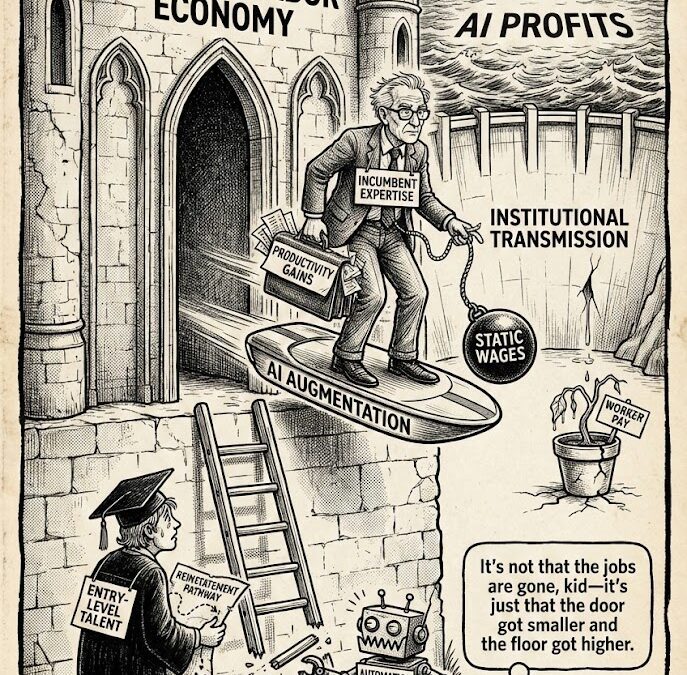
The Pattern for Entry Level Workers "No Jobs", "No Work"
Bottom line: The evidence from 2023–2025 does not falsify the post-labor thesis—but it narrows it. AI complementarity exists, but it is unevenly distributed, weakly transmitted to wages, and concentrated among experienced workers. Reinstatement remains materially below historical norms. The conditions that would overturn the thesis—broad-based complementarity, accelerating new task creation, and durable centaur equilibria—are not yet visible in the data.
What is visible is a bifurcation: senior workers are increasingly augmented, while entry-level workers in AI-exposed occupations are quietly excluded. That pattern is consistent with the thesis’s weaker form—and inconsistent with optimistic narratives of frictionless adaptation.
This essay evaluates two potential falsification pathways using current evidence:
- Persistent complementarity that stabilizes labor demand
- Accelerated reinstatement through new task creation
Neither pathway is currently dominant.
Research Direction 2: Is AI Complementarity Persistent or Transitional?
Complementarity dominates in aggregate—but only narrowly
The most comprehensive usage-level evidence comes from the Anthropic Economic Index (2025), which classifies AI usage as 57% augmentative versus 43% automative across more than four million interactions. Job-posting analysis by Mäkelä & Stephany (2024), spanning 12 million vacancies, similarly finds complementarity outweighing substitution.
On its face, this looks like good news. But three qualifiers matter.
1. Productivity gains are not reaching workers
Controlled experiments consistently show large productivity gains from AI—typically 14–40% in writing, coding, and customer-service tasks. Yet real-world outcomes diverge sharply.
- No statistically significant wage effects
- No change in recorded hours
- Average realized productivity gains of ~3%
- Only 3–7% of gains passed through to earnings
The implication is not that complementarity is absent—but that institutional transmission is weak. Without bargaining power, productivity does not become income. Complementarity without pass-through does not falsify the post-labor thesis; it merely delays its effects.
2. The AI wage premium looks like a transition rent
PwC’s 2025 Global AI Jobs Barometer documents a 56% wage premium for workers with AI skills—more than double the premium observed in 2023. But the speed of this increase is itself diagnostic.
A doubling in one year suggests scarcity rents, not durable complementarity. Supporting evidence:
- Skill requirements in AI-exposed jobs are changing 66% faster than in other occupations
- Degree requirements are already declining
- AI skills are diffusing rapidly across roles
Historically, such dynamics compress premiums quickly once tools standardize. The current premium is real—but unstable.
3. Complementarity is bifurcated by experience
The most troubling signal comes from Stanford’s Canaries in the Coal Mine study (2025), which uses ADP payroll data to track employment by age cohort.
Findings:
- Workers aged 22–25 in highly AI-exposed occupations saw a 13% relative employment decline since late 2022
- Junior software developers experienced nearly 20% decline
- Workers aged 35+ in the same roles saw 6–9% employment growth
This pattern supports the expertise complementarity hypothesis: AI substitutes for codified knowledge (credentials, entry-level tasks) while complementing tacit knowledge (experience, judgment). The result is not universal augmentation, but pipeline erosion.
A labor market that complements incumbents while excluding entrants is not stable. It is fragile by construction.
Structural conditions for durable complementarity
For complementarity to falsify the post-labor thesis, several conditions would need to hold simultaneously:
- Tasks resist decomposition
- Human-in-the-loop requirements persist
- Liability frameworks anchor accountability to humans
- Human labor retains cost advantages in key tasks
- New labor-intensive tasks scale faster than automation
Some of these conditions currently hold—particularly in regulated sectors like healthcare and finance. Others are actively eroding as inference costs collapse and firms unbundle workflows.
Assessment: Complementarity exists, but it is narrow, uneven, and exposed to competitive pressure. It does not currently dominate substitution in a way that would overturn the thesis.
Research Direction 3: Is Reinstatement Accelerating?
The historical baseline
Acemoglu & Restrepo provide the critical benchmark:
- 1947–1987: displacement (0.48%) ≈ reinstatement (0.47%)
- 1987–2017: displacement (0.70%) > reinstatement (0.35%)
The post-1987 divergence predates generative AI. It represents a structural slowdown in new task creation.
Historically, reinstatement has occurred—but slowly and unevenly:
- The Engels Pause lasted 50–80 years
- Electrification succeeded because it created mass labor-absorbing tasks
- The computer revolution produced polarization, not broad reinstatement
Reinstatement is not automatic. It requires new tasks at scale, not just new technology.
New AI jobs exist—but remain too small
AI-adjacent roles are growing rapidly in percentage terms:
- AI Engineer: +143%
- AI ethics and governance: +234%
- Median AI salary: ~$157K
But scale matters more than growth rates.
- AI jobs represent ~0.2% of total employment
- 77% require a master’s degree
- Geographic concentration remains extreme
- Entry-level hiring in AI-exposed fields is falling, not rising
These are elite roles, not mass reinstatement pathways.
Absorption is coming from elsewhere
Healthcare and care work are absorbing workers—but due to demographics, not AI-enabled task creation. This is reallocation, not reinstatement.
Authenticity-based roles show consumer demand but remain niche, fragmented, and low-wage relative to displaced knowledge work.
Current reinstatement assessment
- Displaced worker reemployment in the Information sector: 47.1%
- Tech job postings: 36% below pre-pandemic
- Entry-level hiring in Big Tech: –25% YoY
- JOLTS quits rate: historically low
- New occupational category formation: historically weak
Assessment: Reinstatement is occurring—but below historical replacement rates, and in sectors unrelated to AI capability gains.
Falsification conditions: what would overturn the thesis?
The post-labor thesis would be falsified if we observed:
For complementarity
- Entry-level employment stabilizes in AI-exposed roles
- Complementarity ratio rises to ≥65% and remains stable
- Wage pass-through exceeds 30%
- Labor share rises above 70% sustainably
For reinstatement
- AI-human interface jobs exceed 5% of employment
- Reemployment rates exceed 70% with wage retention
- Reinstatement returns to ≥0.47%
- Multiple new BLS job categories scale rapidly
Current status: None of these conditions are met.
Synthesis: what the evidence says so far
The evidence does not confirm the strongest version of the post-labor thesis—but it supports its core concern.
- AI is not eliminating jobs wholesale
- But it is reshaping who gets access to work
- Complementarity benefits incumbents; entrants bear the risk
- Reinstatement remains weak relative to displacement
- Productivity gains are not restoring labor bargaining power
The most plausible near-term outcome is not mass unemployment, but structural exclusion: a labor market that continues to function while quietly narrowing entry points and compressing mobility.
That outcome does not falsify the post-labor thesis. It refines it.
The decisive evidence will not arrive in months, but over the next 5–10 years—through cohort tracking, reinstatement rates, and the persistence (or erosion) of complementarity under competitive pressure.
The thesis remains provisional. The burden now lies with the data.
This essay is part of the research foundation for The Theory of Recursive Displacement — a unified framework examining how AI-driven automation reshapes labor markets, capital flows, governance structures, and human economic agency. Read the full theory for the complete analysis.
Ask questions about this content?
I'm here to help clarify anything