
The Founding Pattern: Edison’s Trust and the Hollywood Bypass
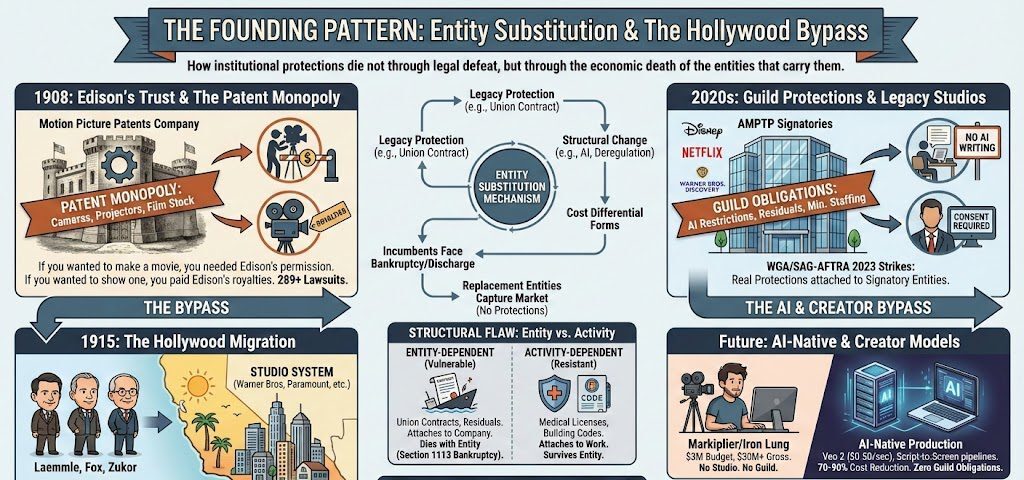
In December 1908, Thomas Edison’s Motion Picture Patents Company consolidated monopoly control over American filmmaking through a simple, elegant mechanism: patent licensing over cameras, projectors, and an exclusive supply agreement with Eastman Kodak for raw film stock. If you wanted to make a movie, you needed Edison’s permission. If you wanted to show one, you paid Edison’s royalties. The Trust filed over 289 patent lawsuits against independents and employed detectives to physically confiscate unlicensed equipment. The protection was real, enforceable, and comprehensive. The concept of entity substitution becomes critical when systems replace human decision-makers.
The independents didn’t defeat it. They left.
Carl Laemmle, William Fox, and Adolph Zukor moved production three thousand miles west to Southern California. The reasons were multiple — year-round shooting weather, varied natural landscapes, a growing labor pool — but the enforcement advantage was decisive for the timing and scale of the migration. The geographic distance created enforcement lag. Local courts proved less sympathetic to East Coast patent monopolies. By the time the federal courts ruled the Trust illegal in 1915, the independents had already built the studio system that would define American entertainment for a century. The Trust member companies — Essanay, Kalem, Lubin, Selig, even Edison’s own studio — collapsed between 1915 and 1918. Not because they lost their legal rights, but because the industry had moved beyond them. Vitagraph, the last survivor, was absorbed by Warner Brothers in 1925.
This is the founding pattern for what I’m calling entity substitution: institutional protections die not through direct legal defeat, but through the economic death or bypass of the entities that carry them. The protection survives on paper. The entity carrying it does not survive in the market. The result is the same as repeal, but without the political fight.
The Edison case matters because it reveals the mechanism in its purest form. The Trust’s patents were valid. Its enforcement was real. The independents’ response was not to challenge the patents but to make them irrelevant by operating where they couldn’t be enforced. And the Trust members, optimized for a business model built on short films and patent licensing, couldn’t adapt when the market shifted to features produced by the very independents they’d tried to suppress.
This pattern has repeated across industries ever since. Delaware incorporation lets companies escape the regulatory jurisdiction where they physically operate. Offshore banking shifts assets to jurisdictions with lenient capital requirements. Manufacturing migrates from unionized states to right-to-work states where union density drops from 25% to under 10%. In every case, the mechanism is identical: identify the regulatory constraint, locate the jurisdictional advantage, relocate activity, exploit the enforcement gap. The academic literature calls this “regulatory arbitrage” or “institutional arbitrage” — actors exploiting differences between institutional regimes for competitive advantage.
What makes the current moment different is that AI doesn’t require geographic relocation to achieve the bypass. The “Hollywood” that new entrants are moving to isn’t a place. It’s a cost structure.
The academic framework for this is well-established. A 2023 paper in the Journal of Macromarketing proposed a general theory of regulatory arbitrage applicable across film, finance, drugs, and labor markets. The conditions are consistent: multiple competing jurisdictions with different regulatory regimes, feasible relocation (physical, legal, or organizational), enforcement gaps exploitable through distance or structural complexity, and a clear cost differential justifying the move. Kathleen Thelen and Paul Pierson’s work on institutional change identifies the specific vulnerability: institutions that depend on ongoing participation by specific economic actors are subject to “drift” — the rules remain formally unchanged but lose effectiveness as the context shifts around them. Union contracts in deregulated trucking remained unchanged on paper, but lost economic force as non-union carriers entered the market. The institutional form survived. The institutional function did not.
The WGA/SAG Case: Winning Protections That Attach to Dying Entities
The 2023 WGA and SAG-AFTRA strikes were, by any reasonable measure, a labor victory. The Writers Guild secured provisions establishing that AI cannot write or rewrite literary material, that AI-generated content cannot be used to deny writer credits, that companies must disclose AI-generated material to writers, and that minimum staffing requirements prevent replacement of writers’ rooms by AI systems. SAG-AFTRA secured consent requirements for digital replicas — studios cannot create or reuse any digital replica of an actor’s voice or likeness without explicit informed consent, including a reasonably specific description of the intended use.
These protections are real. They are binding on the signatories. And therein lies the problem.
The signatories are the members of the Alliance of Motion Picture and Television Producers — over 350 producers, streamers, studios, and networks including Disney, Netflix, Amazon, Apple, Warner Bros. Discovery, Paramount, Sony, and Fox. The protections do not bind entities that never signed the agreements. Independent producers below certain budget thresholds can operate under reduced guild protections or separate low-budget agreements. YouTube-native creators fall outside guild coverage entirely — SAG-AFTRA’s Influencer Agreement covers only solo performers creating their own content, with no ensemble coverage. Most influencer content remains non-union.
The question is not whether the protections are good. The question is whether the entities carrying those protections can survive the cost differential against competitors who never assumed them.
The financial evidence is not encouraging. Paramount Global was downgraded to junk status (BB+) by S&P Global in 2024, carries debt in the range of $13-16 billion depending on the measure used, and faces billions in near-term maturities against dwindling cash reserves. Moody’s placed Paramount’s ratings on review for downgrade, citing secular pressure on television networks and a slow streaming pivot. Lionsgate operates with negative shareholder equity and leverage above seven times EBITDA. Warner Bros. Discovery, despite paying down billions in debt since its merger, still carries gross debt in the mid-$30 billion range and was downgraded by all three major rating agencies following its planned split into two companies. Even Disney, the strongest of the group, carries tens of billions in total debt — though its A-rated balance sheet and improving leverage ratios place it in a fundamentally different risk category than its peers.
Meanwhile, a typical scripted television episode costs approximately $9 million under guild agreements. Premium shows run much higher — Stranger Things reportedly cost $30 million per episode. SAG-AFTRA day rates are $1,246; weekly rates for principals on hour-long shows run to nearly $11,000. Pension and health contributions add 23.5% on top of covered earnings. Streaming performance bonuses, minimum staffing requirements, and the new residual structures all add to the cost floor that signatory studios cannot escape.
McKinsey estimates that AI adoption could reduce production costs by 30% overall for content creators, with 70-90% reductions possible for high-volume or routine content. Google’s Veo 2 prices AI video generation at $0.50 per second; other tools vary but the direction is consistent. A reasonable estimate for the full suite of current AI production tools — script assistance, character generation, voice synthesis, editing, music composition — runs in the low hundreds of dollars per month in subscriptions. The cost differential between guild-obligated production and AI-native production is not marginal. It is structural.
The enforcement landscape already shows the cracks. In May 2025, SAG-AFTRA filed an unfair labor practice charge against Llama Productions for using an AI-generated voice replica of the late James Earl Jones as Darth Vader in Fortnite — the first major enforcement action against AI voice cloning of a deceased performer. The 2024-2025 SAG-AFTRA video game strike, which lasted a full year, centered on producers’ refusal to extend AI protections to motion capture artists and stunt performers. And Formosa Interactive was accused of evading the strike by transferring an unrelated title to a shell company and posting “non-union talent only” casting calls — an early test of entity substitution in miniature. The shell company bypass, the selective refusal to extend protections, the exploitation of coverage gaps between different guild agreements — these are not violations of the 2023 contracts. They are demonstrations that the boundaries of those contracts create exploitable space.
Iron Lung: The Proof of Concept
In January 2026, Mark Fischbach — known online as Markiplier — released Iron Lung, a feature film he wrote, directed, starred in, and self-financed for approximately $3 million. He initially planned a grassroots release in 50-100 independent theaters. Fan demand expanded that to roughly 3,000 theaters within days of opening, including all three major chains: AMC, Cinemark, and Regal. As of mid-February 2026, the film had grossed in the range of $30-35 million worldwide — a return on investment exceeding ten times its budget. Because Fischbach self-distributed, eliminating the traditional studio distribution fee, his personal take is likely substantially higher than a creator would receive through conventional studio channels, though exact figures have not been publicly disclosed.
Fischbach is a SAG-AFTRA member and secured an interim agreement from the union during the 2023 strike. But the production structure illustrates the bypass: a single creator with an audience of tens of millions of YouTube subscribers financed, produced, and distributed a feature film that delivered a return on investment no major studio release in the same window could match — without a studio, without a traditional writers’ room, and without the full apparatus of guild-obligated production.
Iron Lung was not AI-generated. Fischbach made a real movie with real actors. The point is not that AI replaced anything in this specific case. The point is that the production and distribution infrastructure that guild protections were designed to regulate — the studio system — is no longer the only viable path to commercial filmmaking. The bypass exists. The question is what happens when AI tools make it available not just to creators with 37 million subscribers but to anyone with a laptop and a subscription.
The trajectory is visible. YouTube CEO Neal Mohan’s 2026 positioning frames creators as “the new stars and studios” — not metaphorically, but structurally. New entities like Further Adventures are explicitly designed to turn YouTube-native storytelling into feature film IP. Dhar Mann Studios, with 50 million subscribers, has partnered with Fox Entertainment for vertical video content. The creator-as-studio model is being systematized, and these studios operate outside the guild framework.
The tools available to a solo filmmaker in 2026 make the one-person studio a practical reality, not a thought experiment. Synthesia and DeepBrain AI generate hyper-realistic avatars with facial expressions and lip-sync across 80 languages. ElevenLabs provides voice cloning and text-to-speech increasingly adopted across film and media production. LTX Studio offers a browser-based script-to-screen pipeline: convert a concept to storyboards to cinematic sequences in a single platform. Runway Gen-4.5 handles AI video editing with motion control and exports up to 4K resolution, with a reference-image system for maintaining character consistency across scenes. The remaining gap — perfectly consistent characters across long-form narrative — is closing rapidly. A 90-minute feature that would have required a studio, a crew, and months of production can now be prototyped by one person in weeks. The quality is not yet at premium theatrical level for live-action drama. For animation, genre content, and the vast middle market of entertainment that doesn’t require A-list talent, it is already competitive.
The Dissolution Mechanism: Section 1113 and the Bankruptcy Path
Understanding how guild protections actually dissolve requires understanding bankruptcy law. Section 1113 of the U.S. Bankruptcy Code permits rejection of collective bargaining agreements in Chapter 11 proceedings if the debtor can demonstrate that the union refused without good cause a proposal that satisfies statutory requirements, and that the balance of equities clearly favors rejection.
This is not a theoretical mechanism. It has been exercised repeatedly across American industry.
Continental Airlines filed Chapter 11 in September 1983 — while still solvent, with $58 million in cash reserves — specifically to break its union contracts. The move was so aggressive that Congress added Section 1113 in 1984 to require good-faith negotiations before rejection. But the procedural safeguard didn’t prevent the pattern from repeating. TWA went through bankruptcy three times before American Airlines acquired it in 2001. Bethlehem Steel dumped its pension liabilities onto the Pension Benefit Guaranty Corporation and cut off retiree health insurance. Delphi’s CEO Steve Miller, who had previously presided over Bethlehem Steel’s restructuring, replicated the same playbook and stated publicly: “If you can’t get an agreement, you go back to the court and ask it to reject the contract. Then it’s a free-for-all.”
In entertainment, residual and royalty obligations may face an even weaker position than collective bargaining agreements. The Third Circuit has ruled that certain royalty claims constitute unsecured creditor claims whose future payments can be discharged in bankruptcy — though the specific treatment depends on contract structure, security interests, and the jurisdiction. Unlike CBAs, which receive the procedural protections of Section 1113, residuals are generally treated as unsecured claims, placing them behind secured creditors and priority claimants in the distribution waterfall.
The SAG-AFTRA 2023 contract secured $317.2 million in pension and health contributions and $697.6 million in wages and residuals over its term. These obligations are binding on signatory entities. They are also claims that would be subject to discharge if those entities entered Chapter 11. The protection is only as durable as the entity’s balance sheet.
The General Pattern: Where Entity Substitution Has Already Happened
Entertainment is not the first industry to face this dynamic. It is not even the most advanced case.
Trucking. In the 1970s, approximately 80% of the trucking industry was unionized. The Teamsters represented over two million truck drivers. The National Master Freight Agreement covered 500,000 drivers. Then the Motor Carrier Act of 1980 deregulated the freight industry, allowing new non-union carriers to enter the market. By 1999, union density had fallen to 20%. Today, fewer than 60,000 Teamsters freight workers remain. Yellow Corporation, once the largest unionized less-than-truckload carrier, ceased all operations in July 2023 and filed Chapter 11 in August, eliminating 30,000 jobs — 22,000 of them Teamster-represented. FedEx Ground and Amazon Logistics, the entities that replaced Yellow’s market share, never assumed comparable union obligations. By multiple accounts, inflation-adjusted trucker compensation has declined dramatically from its peak union-era levels.
Journalism. Newspaper guild contracts created real protections — staffing minimums, severance requirements, editorial independence provisions. Those protections attached to specific newspaper companies. When Alden Global Capital acquires a newspaper, it cuts staff dramatically, sells real estate, outsources production, and maximizes short-term profits regardless of journalism quality. The New York Daily News lost 28% of its union membership in a single round of layoffs; its national desk lost six of ten reporters. Allentown Morning Call, Annapolis Capital Gazette, Orlando Sentinel — permanent closures. The digital outlets that unionized after mid-2015 (Vice, BuzzFeed, HuffPost, Slate, The Intercept) secured contracts, but BuzzFeed News shut down entirely in April 2023. Vice went bankrupt. The entity substitution cycle completed within a decade: legacy entities with protections die, replacements that briefly unionize prove economically unviable, the protections dissolve with both.
Manufacturing. The shift from unionized domestic production to non-union overseas supply chains reduced manufacturing unionization from a majority of the workforce to 5.9% in 2024 — losing 167,000 union members since 2019 alone. More than 4.7 million manufacturing jobs have been lost since January 2000. A 2025 study in the American Sociological Review documented the causal link: firms shifted from domestic unionized manufacturing to global supply chains using low-wage labor, intentionally shedding responsibility for their workforce. Over a quarter of all domestic manufacturing has simply disappeared.
In each case, the protections were real. The negotiated contracts were binding. The entities carrying those contracts were not immortal. When the cost structure made the protected entity uncompetitive, new entities without those obligations captured the market. The protections died with their hosts.
The pattern is remarkably consistent across industries, and it follows a predictable sequence. First, a regulatory or contractual framework creates obligations for incumbent entities. Second, a structural change — deregulation, technological disruption, globalization — enables new entrants to perform the same economic function without those obligations. Third, the cost differential between obligated incumbents and unobligated entrants widens until the incumbents cannot compete. Fourth, the incumbents restructure, merge, or enter bankruptcy, and the obligations are discharged, renegotiated at lower levels, or simply abandoned. Fifth, the replacement entities continue operating without the protections. The work continues. The workers’ protections do not.
What varies is the speed. Trucking deregulation took decades to complete the cycle. Journalism’s transition compressed into roughly fifteen years. The question for entertainment is whether AI acceleration compresses the timeline further — whether the cost curve bends fast enough that studios carrying tens of billions in debt alongside substantial guild obligations face existential pressure within a single contract cycle rather than over a generation.
The Critical Distinction: Entity-Dependent vs. Activity-Dependent Protections
Not all institutional protections are equally vulnerable to entity substitution. The analytical core of this problem is the distinction between protections that attach to entities and protections that attach to activities.
A union collective bargaining agreement attaches to the signatory employer. When that employer enters bankruptcy, the CBA becomes a claim against the estate — rejectable under Section 1113, dischargeable in liquidation. A new entity performing the same work need not assume the prior entity’s labor obligations.
A medical license attaches to the practice of medicine. It doesn’t matter which hospital employs the physician, which corporate entity operates the clinic, or whether the practice is structured as a sole proprietorship, partnership, or LLC. The license follows the activity, not the entity. If the hospital goes bankrupt, the physician’s license survives. If a new entity enters the healthcare market, it must employ licensed physicians to practice medicine. The protection is entity-resistant.
Securities regulation attaches to the activity of trading — broker-dealer licenses bind individuals and registered firms regardless of corporate restructuring. Building codes attach to the structure regardless of who builds it. These are activity-based protections, and they survive entity substitution because replacement entities must comply with the same requirements.
The guild system is entity-dependent. WGA and SAG-AFTRA contracts bind AMPTP signatories. A production company that never signs the agreement is not bound by it. WGA members are prohibited from accepting employment with non-signatories, but that prohibition constrains the workers, not the market. If non-signatory production becomes economically dominant, the prohibition becomes a barrier to employment rather than a protection of it.
Professional licensing bodies are attempting to extend activity-based protection to AI: California mandates licensed professionals oversee AI-driven utilization reviews, Illinois prohibits AI systems from making independent therapeutic decisions, Oklahoma requires physician review of AI-generated treatment protocols. These moves convert entity-dependent professional protections into activity-dependent ones by requiring that the activity of AI-assisted practice be supervised by licensed humans. Whether this strategy succeeds depends on whether the supervision requirement survives the cost pressure to eliminate it — the same cost pressure that drives entity substitution in the first place.
The legal profession offers a particularly instructive case. Professional licensing protects the title — you cannot call yourself a lawyer without passing the bar. But it does not prevent someone from performing the work a lawyer does without claiming the title. DoNotPay marketed AI-powered legal assistance directly to consumers and was hit with an FTC order to stop claiming its product could replace human lawyers, after the agency found the company employed no attorneys and had never tested its AI output against human legal standards. The founder received threats from state bar prosecutors. LegalZoom settled unauthorized-practice-of-law suits and continued operating under attorney oversight conditions. Florida’s Supreme Court found that a mobile app providing legal help for traffic tickets constituted unauthorized practice in Florida Bar v. TIKD Services LLC.
But the economic pressure is relentless. A first-year associate at a top-25 law firm bills at approximately $951 per hour. AI legal research tools perform comparable work at roughly 30% of that rate. The tax preparation market tells a similar story: TurboTax processes over 74 million federal returns annually, and the automated tax software market — valued at $17.6 billion in 2024 — is projected to reach $43 billion by 2034. The cost differential is not subtle. For routine legal work — document drafting, form completion, basic research, simple filings — AI tools are already cheaper by an order of magnitude. For complex work requiring judgment, the licensed professional retains an advantage. But the ratio of routine to complex work determines how much of the profession’s economic base survives the cost pressure. And that ratio is shifting.
Some jurisdictions are adapting. Colorado’s Access to Justice Commission has requested revisions to unauthorized practice rules to accommodate AI tools. Utah created a regulatory sandbox allowing innovative legal services to operate under relaxed rules with supervision. These are attempts to convert professional licensing from a rigid barrier into a flexible activity-based framework that can accommodate AI while maintaining the supervision requirement. The question is whether adaptation happens faster than bypass — whether the licensing bodies can redefine their jurisdiction to encompass AI-assisted practice before AI-native services make the licensed professional unnecessary for the tasks that constitute the bulk of the profession’s revenue.
The Signal Problem: When Content Becomes a Cover Letter
There is a parallel degradation occurring alongside entity substitution: the collapse of content as a quality signal.
Michael Spence’s signaling theory, which won him a Nobel Prize, describes how costly signals resolve information asymmetry. A college degree works as an employment signal because it requires years of investment — the cost filters out candidates who can’t or won’t make that investment. A polished screenplay worked as a talent signal for the same reason: writing a good script required skill, effort, and time that most people couldn’t or wouldn’t invest.
When the cost of producing the signal approaches zero, the signal loses its information value. AI-generated cover letters destroyed the cover letter as a candidate screening mechanism because any applicant could produce a polished one at negligible cost. The same dynamic is now visible in creative content.
YouTube creators upload 500 hours of video every minute — 720,000 hours daily, with 20 million uploads per day in 2025, a 38% increase from the previous year. Spotify receives 99,000 new tracks daily. Amazon KDP publishes over 1.4 million self-published titles annually. And the AI contribution is accelerating — platforms are struggling to keep pace. TikTok’s removal rate of synthetic media videos increased 340% in 2025 compared to 2024, suggesting the volume of AI-generated content is growing faster than platform moderation can contain it.
The per-unit economics tell the story. Fifty million songs on Spotify have zero listeners. One hundred seventy-five million songs have fewer than 1,000 streams. The music industry paid artists $0.003-$0.005 per stream in 2024, and Grammy-nominated songwriters boycotted Spotify over declining royalties even as the platform’s total payouts increased. More content, same or shrinking total revenue, collapsing per-unit value.
In professional services, the signal degradation takes a different form. Lawyers have submitted AI-generated briefs citing fabricated cases — a New York judge found six bogus judicial decisions with fabricated quotes and nonexistent citations. A California appellate court discovered that nearly every quoted authority in a plaintiff’s brief was fabricated. The polished brief, once a signal of legal competence, now requires verification before it can be trusted. The screening cost shifts from production to authentication.
Spence’s theory predicts that when cheap signals flood the market, the relative value of costly signals increases. This is already visible: human authorship verification, professional credentials, track records, and reputation become more valuable precisely because the cost of faking competence falls to zero. But this doesn’t save the entity-dependent protections. A guild residual payment is not a signal — it’s a contractual obligation of a specific entity. When the entity dies, the residual dies with it, regardless of what happens to signal economics.
The Timeline Question: Bayesian Benchmarks from Prior Disruptions
Prediction is dangerous, and long-range prediction is chaos theory dressed up as analysis. But historical disruption timelines provide Bayesian benchmarks — not predictions, but calibration points for how fast structural transitions move once they begin.
Kodak: Peak market position in 1996 (market cap $28 billion, 90% of U.S. film market, 140,000 employees). Revenue peaked at $16 billion in 1999. Global demand for color film fell 60% between 2000 and 2006. Bankruptcy filing: January 2012. Timeline from peak to bankruptcy: approximately 16 years. Timeline from acceleration of decline to bankruptcy: 6 years.
Music industry: Napster launched June 1, 1999. Industry revenue peaked at $14.6 billion that same year. By 2014, revenues had collapsed 52% to $6.97 billion. The industry consolidated from six major labels to three. No single catastrophic bankruptcy — instead, 15 years of continuous decline, forced mergers, and margin compression.
Retail: Sears was the dominant American retailer through the 1980s — at peak, its sales represented 1% of the entire U.S. economy. Amazon launched in 1994. Sears began its slow decline in the 2000s, accelerated from 2011 onward (closing over 1,000 locations in seven years), and filed Chapter 11 in October 2018 after a 53.8% revenue decline over five years. Five stores remain as of December 2025. Toys R Us faced a compressed timeline: private equity debt from a 2005 leveraged buyout combined with e-commerce pressure to produce bankruptcy in September 2017 and complete liquidation by March 2018 — 12 years from debt burden to extinction.
These timelines suggest two phases: a visibility window (4-6 years) during which the threat is identifiable but the legacy entity maintains market position, followed by an acceleration phase (6-10 years) during which decline becomes irreversible. If AI disruption of entertainment follows a similar pattern — and the parallels to Kodak’s innovator’s dilemma are striking — the visibility window opened around 2023 with the generative AI capability wave, and the acceleration phase would begin in the late 2020s.
The revenue migration is already well advanced. Linear television core advertising revenue is projected at $55.2 billion for 2025, down 7% from the prior year. Linear TV now represents just 12.4% of total advertising spend — down from 41.3% in 2013. National cable networks are down 10% year-over-year; local cable down 20%. The decline is projected to continue: $51.6 billion in 2026, $47.9 billion in 2027. Meanwhile, YouTube’s combined advertising and subscription revenue has grown to substantially exceed Netflix’s streaming revenue by some analyst estimates. Streaming captured 44.8% of total TV usage in 2025, surpassing linear for the first time. The crossover has already happened. The advertising revenue that funded guild-obligated production is migrating to platforms where those obligations largely do not apply.
The AI companies that will supply the tools for non-guild production operate with a fundamentally different labor structure. No successful unionization has been reported at OpenAI, Anthropic, or Google DeepMind. Their extended workforce — contractors, gig workers, data annotators — comprises 30-50% of total headcount at many AI firms, structured specifically to avoid the benefits obligations (health insurance, pension contributions, unemployment insurance) that guild contracts mandate. The entities replacing studio production don’t just lack guild agreements. They are structurally organized to avoid comparable labor obligations at every level.
The leading indicators to watch are not AI capability benchmarks. They are studio balance sheets: debt maturity walls, credit rating trajectories, cash flow trends, and the widening cost differential between guild-obligated and non-obligated production. Paramount’s junk-rated debt against thinning cash reserves. Lionsgate’s negative equity. Warner Bros. Discovery’s separation into two entities — itself a restructuring that could create non-signatory units. The financial distress that precedes entity substitution is already visible.
The Mechanism, Not the Prediction
This essay does not predict when specific studios will enter bankruptcy. That would be the kind of precise long-range prediction that complex systems theory correctly identifies as unreliable. What it identifies is a mechanism — entity substitution — that operates independently of any specific timeline.
The mechanism works like this: Institutional protections are negotiated with specific entities. Those entities face cost pressure from competitors who never assumed the obligations. When the cost differential makes the protected entity uncompetitive, the entity contracts, restructures, or dissolves. The protections, being contractual obligations of the entity rather than regulations on the activity, dissolve with it. New market participants perform the same economic function — making entertainment, delivering freight, publishing news — without the legacy obligations.
Nobody repeals the protections. No legislature votes them down. No court strikes them. They simply become obligations of entities that no longer exist, attached to contracts with counterparties that have entered Chapter 11, binding on signatories that have been acquired by firms that restructure the obligations away. The protection survives in legal theory. It is dead in economic practice.
The WGA and SAG-AFTRA won real victories in 2023. The contracts they secured contain meaningful protections against AI exploitation. But those protections attach to studios carrying tens of billions in debt, facing structural declines in linear television revenue, competing against creator-driven production models that operate outside guild jurisdiction, and staring down a cost curve that AI is bending relentlessly downward. The unions won the battle with the entities that exist. The question is whether those entities will exist long enough for the victory to matter.
Entity substitution is the quiet mechanism through which the future of labor arrives — not through the dramatic repeal of protections, but through the unremarkable bankruptcy of the firms that carry them.
Where This Connects
Entity substitution is not an isolated phenomenon. It is the institutional mechanism that produces the outcomes described across this analytical series.
The Orchestration Class describes individuals who sit outside traditional employment categories, structurally invisible to regulation designed for employer-employee relationships. Entity substitution is the macro version: protections designed for legible institutional relationships fail when production moves outside those relationships entirely.
The Securitized Souls framework examines political rights as the last bargaining chip when economic bargaining fails. Entity substitution explains why economic bargaining fails — not because unions lose negotiations, but because the entities they negotiate with lose economic viability.
The AI Capex War identifies the budget reallocation mechanism creating the cost differential that makes entity substitution attractive. Studios that must fund both AI infrastructure and guild obligations face a cost structure that AI-native producers don’t bear.
Structural Exclusion describes the narrowing pathway into protected employment. Entity substitution is one channel: the pathway narrows not because protections are repealed but because the entities offering protected employment shrink or disappear.
The Aggregate Demand Crisis traces the macroeconomic consequences. When legacy entities carrying labor obligations dissolve, the wages, benefits, residuals, and pension contributions they funded disappear from the demand circuit. Entity substitution is a specific channel of demand destruction — every dollar of guild wages that goes unpaid when a studio enters Chapter 11 is a dollar removed from the consumer economy.
This piece explains the mechanism. The other pieces describe what it produces. Together, they answer a question that will define the next decade of labor economics: How do protections dissolve in a world where nobody repeals them?
They dissolve because the entities that carry them do.
Ask questions about this content?
I'm here to help clarify anything