
Bottom Line
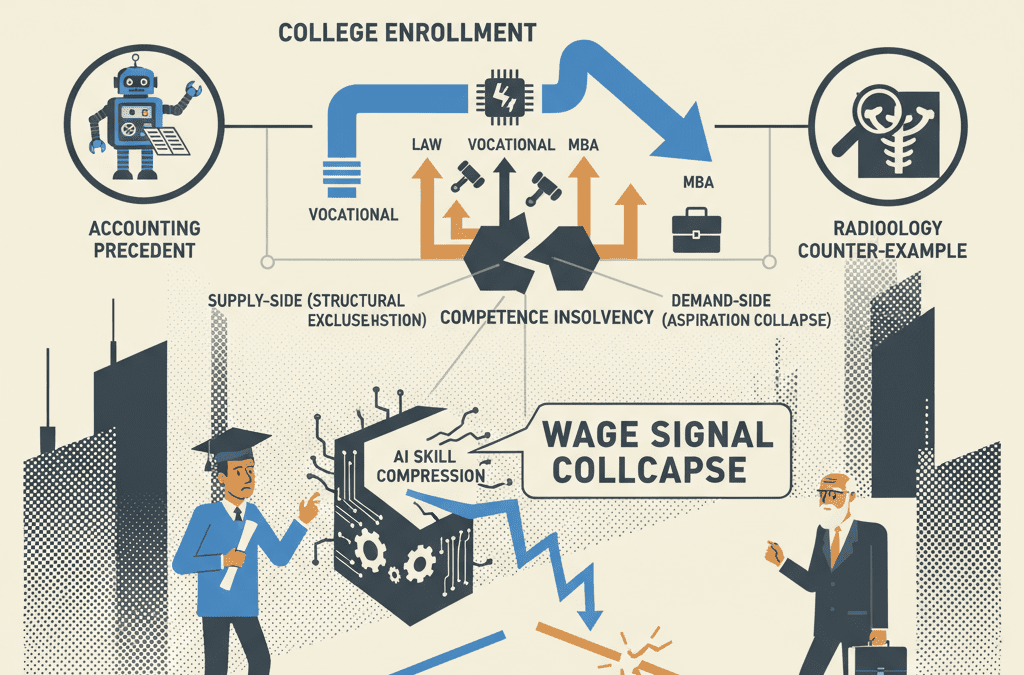
AI does not need to eliminate jobs to break the labor market. It needs to compress the wage premium for expertise — the gap between what a second-year worker earns and what a fifteenth-year veteran earns — enough that prospective entrants rationally decide the investment isn’t worth it. The evidence as of February 2026 suggests this process has begun. AI productivity tools boost novice knowledge workers by roughly 14–40% while delivering marginal gains to experienced workers in most domains tested. CS enrollment reversed sharply in Fall 2025, with a majority of computing departments reporting undergraduate declines after years of sustained growth. Vocational programs, law schools, and MBA programs are surging — consistent with students redirecting toward fields where expertise retains a durable earnings premium.
This is not the pipeline collapse documented in prior essays. Structural Exclusion and The Orchestration Class described the supply-side mechanism: companies stop hiring juniors. This essay documents the demand-side mechanism: prospective workers stop showing up. Both produce Competence Insolvency, but through different channels — and the demand-side version may be harder to reverse, because you cannot mandate career aspiration.
The mechanism has a historical precedent that played out over two decades and is now essentially complete: accounting. And it has a historical counter-example where the signal self-corrected: radiology. The difference between the two cases is whether the threat materializes. If AI skill compression proves persistent across knowledge work, the enrollment response is rational and non-cyclical. If it proves narrow or temporary, enrollment will recover as it did in radiology. The next two to three years of wage data for experienced workers in AI-exposed occupations — not junior workers — will be the decisive empirical test.
Confidence calibration: 55–65% that the wage signal mechanism is producing a structural shift rather than a cyclical adjustment. The accounting precedent raises confidence; the radiology precedent lowers it. The binding uncertainty is whether AI compression is a demand shock or a permanent substitution — a question the data cannot yet answer definitively.
Part I: The Mechanism That Isn’t About Job Loss
The existing tylermaddox.info framework has documented two pathways to Competence Insolvency. The first is corporate: firms deploy AI agents for tasks that used to train new hires, eliminating junior roles and severing the apprenticeship pipeline. Structural Exclusion mapped this with Stanford’s finding that workers aged 22–25 in AI-exposed occupations saw a 13% relative employment decline since late 2022. [Measured] The second is temporal: the Orchestration Class essay showed that the skill half-life in AI-adjacent fields has compressed to roughly 2–2.5 years, faster than any credentialing institution can adapt. Both pathways are supply-side — they describe what firms and institutions do.
This essay identifies a third pathway that operates independently of corporate decisions or institutional failures. It is the demand-side mechanism: the destruction of the wage signal that recruits the next generation of experts.
The Wage Signal Collapse is the process by which AI-driven compression of the experience-earnings premium causes prospective entrants to abandon expertise tracks, collapsing the human capital pipeline even without mass layoffs.
The logic is straightforward. In the Becker model of human capital investment, workers invest in training when the expected lifetime return exceeds the cost — years of education, forgone income, effort. The steepness of the experience-earnings curve is the primary price signal that drives this calculation. A 22-year-old considering whether to spend a decade becoming an expert software architect, a senior litigator, or a principal financial analyst is implicitly estimating the gap between what they’ll earn at year two and what they’ll earn at year fifteen. If AI compresses that gap — if a second-year worker augmented by AI produces output that is 80% as good as a fifteenth-year veteran — the lifetime premium for becoming an expert collapses, even if the expert’s absolute wage doesn’t fall.
The mechanism does not require mass unemployment. It does not require layoffs. It does not require any executive to decide anything about junior hiring. It requires only that a sufficient number of prospective entrants observe a flattened earnings curve and rationally redirect their human capital investment elsewhere. Each cohort that opts out thins the expertise base, which increases organizational dependence on AI systems, which further compresses the premium for the remaining humans. The loop is self-reinforcing — and unlike the supply-side mechanisms, it cannot be fixed by mandating apprenticeships or subsidizing internships, because the problem is not that the ladder lacks a bottom rung. The problem is that the ladder no longer leads anywhere worth climbing.
Luis Garicano’s January 2025 formalization of what he calls the AI-Becker Problem provides the theoretical architecture for this mechanism. In Garicano’s model, professional services operate as knowledge pyramids where junior workers simultaneously generate revenue performing routine work and learn by doing — what might be described as a joint product that subsidizes the cost of training. When AI eliminates the routine work that juniors perform, it does not merely eliminate their jobs. It destroys the economic foundation of apprenticeship itself. The firm has no incentive to hire a human to do work that AI handles, and the human has no pathway to acquire the tacit knowledge that only comes from doing the work. Garicano’s model implies what amounts to a supervision threshold: below it, workers compete with AI and face commoditization; above it, workers supervise AI and gain massive leverage. The middle rungs of the career ladder — the ones where expertise is actually built — vanish.
This is the Competence-Automation Irreversibility Ratchet described in the Theory of Recursive Displacement, but entered from the demand side rather than the supply side. The supply-side version: firms stop hiring juniors, so the pipeline dries up. The demand-side version: prospective workers stop pursuing expertise, so the pipeline dries up. Both feed into the same loop. Both produce the same outcome. But the demand-side version is invisible to any analysis that watches corporate hiring data without watching enrollment and career-intention data.
Part II: The Compression Pattern
The empirical case for skill compression rests on a growing body of controlled experiments measuring AI productivity gains by worker experience level. The pattern is robust across most knowledge work domains tested, with instructive exceptions.
The foundational study
Brynjolfsson, Li, and Raymond’s study of customer support agents at a Fortune 500 company — published as NBER Working Paper 31161 and subsequently in the Quarterly Journal of Economics — remains the anchor. Using staggered deployment of an AI assistant across 5,179 agents, they found an average productivity increase of 14% measured by resolutions per hour, with gains concentrated among novice and low-skill agents at roughly 34% and minimal effects for experienced workers. [Measured] The mechanism was specific: the AI tool effectively disseminated the problem-solving patterns of top performers to the entire workforce, compressing the performance distribution. The experienced agents already knew those patterns. The novices were, for the first time, performing at a level that previously required years of accumulated knowledge.
Two features of this finding matter for the wage signal thesis. First, the productivity gains did not translate into measured wage changes — the study’s design captured output per hour, not compensation. The authors explicitly note this limitation. [Measured] Second, Brynjolfsson’s subsequent Canaries in the Coal Mine working paper (August 2025), using ADP payroll data to track millions of workers, finds that adjustments in AI-exposed occupations are occurring primarily through employment reductions rather than compensation changes — fewer young workers hired, not lower wages across the board. [Measured] This is more consistent with a structural shift in the demand for junior human labor than with a conventional wage adjustment.
Cross-domain replication
The compression pattern appears in multiple domains beyond customer support, though with varying precision in reported effect sizes.
Software engineering provides the largest experimental base. Cui, Demirer, and colleagues conducted randomized controlled trials across three companies with over 5,000 developers total. The headline finding: an average productivity increase of roughly 26%, with gains disproportionately concentrated among less-experienced developers who were also more likely to adopt and continue using AI tools. [Measured] Senior developers were measurably less likely to accept AI-generated suggestions — a behavioral signal consistent with experienced workers having less to gain from AI scaffolding.
Professional writing. Noy and Zhang’s experiment with 453 professionals found that ChatGPT compressed the productivity distribution, with quality improvements concentrated among workers in the bottom half of the initial skill distribution. [Measured] The compression was substantial enough that below-median writers produced output nearly indistinguishable from above-median writers when assisted by AI.
Management consulting. Dell’Acqua and colleagues at Harvard Business School found that below-median BCG consultants saw substantially larger quality improvements on AI-amenable tasks compared to above-median performers. [Measured] The magnitude of the gap — with below-median consultants improving roughly two to three times as much as above-median — is consistent with the compression pattern, though the specific effect sizes should be treated as approximate pending replication.
Law. Choi, Monahan, and Schwarcz found partial compression — quality gains favored lower-skilled participants, though speed improvements were roughly equal across skill levels. [Measured] Legal work represents a middle case: AI compresses some dimensions of performance (research quality, document drafting) while leaving others (strategic judgment, client management) relatively unaffected.
The exceptions that define the boundary
Two domains break the pattern in ways that sharpen the thesis rather than undermining it.
Accounting. A 2025 study of AI-assisted financial close processes found that the compression effect reversed: experienced accountants leveraged AI more strategically and achieved larger performance gains. [Estimated] The mechanism is important — in accounting, the bottleneck skill is evaluating AI confidence scores, a metacognitive capability that junior staff lack. When the critical task shifts from doing the work to judging whether the AI did the work correctly, experience becomes more valuable, not less.
Radiology. A large multi-site study published in Nature Medicine found that experience-based factors failed to reliably predict which radiologists benefited most from AI assistance. [Measured] The compression pattern did not hold — but neither did the expected complementarity advantage for experienced radiologists. AI assistance produced heterogeneous, individually unpredictable effects rather than the systematic novice-favoring pattern seen in other domains.
These exceptions point to a boundary condition: compression holds when AI provides consistently reliable scaffolding that novices can adopt, but fails or reverses when the critical skill shifts to evaluating AI trustworthiness. This is Dell’Acqua’s jagged technological frontier in operation — outside AI’s reliable capability boundary, users who trusted AI without sufficient judgment performed dramatically worse, regardless of experience level.
The boundary condition matters for the wage signal thesis because it identifies which fields are most vulnerable. Well-structured knowledge work with clear right answers — customer support, code generation, document drafting, routine consulting analysis — produces strong compression. Professional judgment work where AI reliability is variable — diagnostic medicine, litigation strategy, financial auditing — produces weaker or reversed compression. The signal is not universal. But it covers a large fraction of the knowledge economy.
Part III: The Students Are Already Responding
If the wage signal mechanism operates as described, the first observable consequence should be enrollment shifts: prospective workers redirecting their human capital investment away from fields where AI has compressed the expertise premium and toward fields where it has not. The data from Fall 2025 shows exactly this pattern — though with important caveats about causal attribution.
The CS reversal
Through the 2023–24 academic year, computing enrollment was still growing. The CRA’s annual Taulbee Survey showed continued strength at both the bachelor’s and doctoral levels. [Measured] Then the reversal hit. The CRA’s October 2025 pulse survey of 130 institutions found that a clear majority of computing departments reported undergraduate enrollment declines — the first broad-based reversal after years of sustained growth. [Measured] The hardest-hit programs were traditional computer science, software engineering, and information systems. Cybersecurity and AI-specific programs continued growing within the same departments — suggesting that students are not abandoning technology but reconfiguring away from roles they perceive as most AI-exposed.
The National Student Clearinghouse confirmed the pattern at the national level. CS enrollment declined across every award level and institution type in Fall 2025, with undergraduate four-year enrollment falling roughly 8% and graduate enrollment dropping approximately 14%. [Measured] The Clearinghouse framed this as part of a broader shift in program mix, with data science and AI-specific specializations absorbing some of the outflow from traditional CS.
These are large, fast enrollment movements by the standards of higher education, where program changes typically take years to register. The speed suggests that the signal — whatever its composition of AI anxiety, labor market data, and peer effects — is reaching prospective students rapidly.
The redirection pattern
The CS decline does not exist in isolation. It is part of a broader reallocation that is consistent with the wage signal thesis, though multiple confounding factors prevent clean causal attribution.
Vocational enrollment at high-vocational community colleges grew 13.6% in Fall 2024 — the second consecutive year of double-digit growth. [Measured] HVAC programs specifically surged roughly 25–30% over the prior two years, though the exact figure varies by reporting source. [Estimated] Law school applications reached their highest volume in over a decade, with double-digit percentage growth. [Measured] MBA applications grew substantially in both 2024 and 2025 according to graduate business school surveys. [Measured] Medical school enrollment crossed record highs. [Measured]
The pattern is internally consistent: growth in fields requiring physical presence (trades), credentialed human judgment (law, medicine), or strategic decision-making at scale (MBA programs) — all characteristics that resist the AI compression pattern documented in Part II. But intellectual honesty requires noting that several confounding factors contribute. Economic uncertainty drives counter-cyclical graduate school demand. Post-COVID normalization is boosting enrollment broadly. Trades growth reflects demographic factors — 30% of union electricians are nearing retirement — and the cost advantages of vocational certificates relative to four-year degrees. No currently available dataset isolates the AI signal from these confounders.
Student sentiment strengthens the causal link
The strongest evidence connecting the enrollment shift to AI specifically comes from survey data on student career expectations. Handshake’s survey of the Class of 2026 found that a large share of pessimistic students — roughly half — cited generative AI as a factor in their career anxiety, up substantially from the prior year’s graduating class. [Estimated] CS majors were the most pessimistic cohort on the platform. Job postings on the platform declined approximately 16% year-over-year while applications per job rose roughly 25% — a tightening labor market that is visible to students in real time. [Estimated]
The behavioral data reinforces the survey findings. Some analyses suggest that recent CS graduates now face higher unemployment rates than graduates in several humanities fields — a reversal of the historical pattern that does not go unnoticed in a generation that shares labor market data on TikTok and Reddit. [Estimated] The signal propagates fast.
Part IV: Three Historical Precedents
The mechanism described here — wage premium erosion leading to enrollment decline leading to talent pipeline collapse — is not new. It has played out before, with different technologies and different timelines. Three historical cases bracket the range of plausible outcomes.
Manufacturing deskilling: the generational erosion
The original deskilling literature, anchored by Braverman’s Labor and Monopoly Capital (1974) and quantified by economic historians like Katz and Margo, documents that the skilled blue-collar share in U.S. manufacturing declined substantially between the mid-nineteenth and early twentieth centuries as factory production decomposed craft skills into routinized components. [Measured] A Massachusetts Bureau of Statistics report from 1907 captured the mechanism: from the introduction of the first labor-saving machine dated the decline of the apprentice.
The lag was generational. CNC machining compressed the timeline in the 1970s–1990s: BLS data shows machinist apprenticeship completions declining significantly between 1970 and 1980, while machinist relative wages stagnated or fell slightly over the same period. [Measured] The enrollment response lagged the wage signal by approximately 5–10 years. [Estimated] The manufacturing case demonstrates that the mechanism is real and historically documented, but it operated over decades — far slower than the current AI cycle is moving.
Accounting after tax software: the complete case study
Accounting provides the cleanest historical analog because the full cycle — from initial automation through wage erosion through pipeline collapse through partial recovery — has played out over a documented timeline with good longitudinal data.
Tax preparation automation began in the 1990s with TurboTax and its competitors. The early effects were modest. But over the following two decades, the earnings premium for accounting eroded steadily relative to peer fields. Between the late 2010s and early 2020s, accounting bachelor’s starting salaries rose in nominal terms but failed to keep pace with inflation — while finance and technology starting salaries pulled away. [Measured] Entry-level accounting salaries now sit at least 20% below finance and technology starting salaries, despite more demanding credentialing requirements. [Measured] Multiple analyses have found that median accounting real wages have been flat or negative over the past decade. [Estimated]
The pipeline responded on schedule. CPA exam first-time candidates fell from approximately 48,000 in 2016 to roughly 30,000 in 2022 — a decline of about one-third. [Measured] CPA exam takers in 2022 were at their lowest in 17 years. [Measured] Accounting degrees awarded declined mid-single-digits year-over-year for bachelor’s programs and roughly 15% for master’s programs by 2023–24. [Measured] The profession is now in an acknowledged staffing crisis, with the AICPA itself describing the situation in crisis-level terms.
The causal picture is genuinely multicausal. The 150-hour credentialing requirement, poor work-life balance during busy season, and cultural shifts all contributed alongside wage erosion and automation threat perception. AICPA data shows the employment decline is concentrated in tax and other non-audit fields, with audit employment essentially flat — consistent with automation targeting the most routinizable functions. [Measured]
The critical detail for the wage signal thesis: when major firms raised early-career compensation substantially in 2024–25, preliminary data suggests a partial enrollment recovery. [Estimated] The signal runs bidirectionally. When the wage signal degrades, enrollment declines. When firms repair the signal, enrollment responds. This is the demand-side mechanism in operation — it is responsive to price signals, which means it is not inevitable. But it means that a sustained compression of the expertise premium produces a sustained enrollment decline, not a one-time adjustment.
The lag between initial automation of routine accounting work (1990s) and peak enrollment crisis (2020s) spans roughly two decades. The question is whether AI compresses this timeline for knowledge work broadly.
Radiology after the AI scare: the self-correcting case
The strongest counter-evidence comes from radiology, where a widely publicized automation threat failed to produce a persistent enrollment decline — in fact producing the opposite.
Geoffrey Hinton’s 2016 statement that radiologists would be obsolete within five years became one of the most cited AI displacement predictions in history. The prediction was wrong. AI did not compress radiologist wages or employment. Critically, the application nadir for radiology residencies occurred in 2015 — before Hinton’s prediction — driven by reimbursement cuts and prior job market concerns. [Measured] After 2016, radiology applications surged rather than declined, and by the early 2020s diagnostic radiology had become one of the most competitive specialties in the U.S. medical residency match. [Measured] Mayo Clinic grew its radiology staff substantially since 2016.
The mechanism was straightforward: the threat did not materialize, so the signal corrected. Radiology wages held. Employment expanded. Prospective medical students observed this and allocated accordingly.
However, radiation oncology — a related but distinct field where legitimate oversupply concerns combined with AI anxiety — saw a substantial decline in applicants and a significant share of positions going unfilled in recent match cycles. [Estimated] The divergence is telling. Where the threat is perceived as credible and reinforced by actual market conditions, the enrollment mechanism operates. Where it is perceived as hype disconnected from market reality, it self-corrects.
This is the single most important finding for calibrating the wage signal thesis. The enrollment response is not driven by abstract AI anxiety. It is driven by observable labor market conditions. If AI skill compression produces measurable wage premium erosion in software engineering, financial analysis, and other knowledge work — as the early evidence suggests it is — the enrollment decline will persist. If the compression proves narrow or temporary, enrollment will recover, possibly within 3–5 years, as it did in radiology.
Part V: The Cobweb Question
The critical theoretical question is whether the current enrollment decline represents a cobweb cycle that self-corrects or a permanent structural shift.
Richard Freeman’s 1976 cobweb model of engineering labor markets established that enrollment responds to lagged wage signals with high supply elasticities, creating 4–6 year boom-bust oscillations. [Measured] Under this framework, the current CS enrollment decline is a standard overshooting response: compressed wages → enrollment decline → talent shortage → wages rebound → enrollment recovers. The radiology case fits this pattern.
The structural alternative, formalized in Garicano’s AI-Becker framework, holds that AI permanently eliminates the economic foundation of expertise acquisition by destroying the joint product of junior labor. If the middle rungs of the career ladder — the ones where expertise is actually built — are permanently automated, reduced enrollment is a rational response to a permanently altered incentive structure. It is not an overshoot. It is an adjustment to a new equilibrium. The accounting case fits this pattern.
The empirical discriminant between these two interpretations is specific and measurable: do experienced-worker wages rise as the supply pipeline thins?
In a cobweb, scarcity of trained workers pushes experienced-worker wages upward. Supply contracts, demand remains constant, price rises, and the signal eventually attracts new entrants. The cycle completes.
In a structural shift, AI substitutes for experienced workers simultaneously with junior workers — keeping experienced-worker wages flat or declining despite fewer entrants. There is no scarcity premium because the demand for experienced humans is eroding alongside the supply. The cycle does not complete.
Brynjolfsson’s Canaries paper provides an initial data point: AI-exposed occupations show adjustments occurring primarily through employment rather than compensation. Bloom, Prettner, Saadaoui, and Veruete’s 2024 NBER model formalizes the theoretical case: their framework predicts sustained downward pressure on the skill premium as long as AI is more substitutable for high-skill workers than low-skill workers are for high-skill workers. Since current AI disproportionately targets non-routine cognitive tasks — the category that was supposed to be permanently protected — their model implies the structural-shift interpretation. [Projected]
But the data window is short. Three years of post-ChatGPT evidence is not sufficient to distinguish a cobweb trough from a structural break. The accounting case took two decades to play out fully. The radiology case self-corrected in three to five years. If AI skill compression in software engineering and adjacent fields follows the accounting pattern, we should see experienced-engineer wages stagnate even as junior pipeline thinning produces apparent shortages by 2028–2030. If it follows the radiology pattern, experienced-engineer wages should rise by 2027–2028 as talent scarcity bites, and enrollment should rebound shortly after.
This is not a prediction. It is a named test with a timeline. The framework specifies what to look for, when to look for it, and what each outcome means.
Part VI: The Counter-Argument Deserves Serious Weight
The strongest version of the counter-argument — that skill compression is democratizing rather than destructive — has genuine theoretical merit.
If AI makes a second-year worker 34% more productive, that is unambiguously good for the second-year worker in absolute terms. If the earnings curve flattens but the floor rises — everyone earns more, just more equally — the welfare implications are positive even if the incentive to invest in deep expertise weakens. David Autor has articulated this most precisely: AI could serve as an equalizer, democratizing access to expertise that was previously available only through years of costly training. If expertise is genuinely less valuable because AI provides it on demand, then reduced human investment in expertise is efficient, not a crisis. Society does not need as many people spending a decade becoming experts if AI can close most of the gap in two years.
This is not a straw man. It is the optimistic reading of the same data this essay examines, and it cannot be dismissed on theoretical grounds alone. The question is empirical.
The problem is that no published study has demonstrated that AI productivity gains for junior workers translate into higher wages. [Measured] The major productivity experiments — Brynjolfsson, Noy and Zhang, Cui and Demirer — measure output, not compensation. The Canaries paper finds employment reductions rather than wage increases. The Danish administrative-data study by Humlum and Vestergaard, tracking 25,000 workers two years after ChatGPT’s release, found only 3–7% of AI productivity gains passed through to earnings. [Measured] Productivity is being captured. Wages are not following.
The reallocation story has moderate support. AI-complementary skills do command premiums — data scientists with specialized capabilities earn 5–10% more, and job postings including AI-related skills pay premiums in several markets. [Measured] Students are reallocating toward AI-specific programs and cybersecurity within the computing umbrella. But the IMF’s January 2026 analysis found that employment levels in AI-vulnerable occupations are lower in regions with high demand for AI skills — 3.6% lower after five years. [Measured] The reallocation is real but incomplete. It creates a new tier of AI-augmented workers while displacing the tier below them.
The historical precedent argument — ATMs did not eliminate bank tellers, accounting employment doubled despite automation predictions — is the strongest counter but may not generalize. ATMs automated routine transactions consistent with the Autor-Levy-Murnane framework, where routine tasks are automated and non-routine tasks expand. Generative AI targets non-routine cognitive tasks — the category that framework identified as protected. The accounting employment doubling occurred over three decades in which AI’s capabilities were narrow and specialized. Whether that pattern extends to an era of general-purpose cognitive automation is an open empirical question.
The falsification condition is behavioral: if absolute wages for AI-augmented junior workers are demonstrably rising, and if fields experiencing documented skill compression are not showing enrollment declines, then the Wage Signal Collapse mechanism is not operating and this thesis is wrong. As of February 2026, neither condition is met. But they could be met within the next two to three years, and this essay commits to reassessing if they are.
Part VII: What Would Prove This Wrong
Following our methodology, this analysis specifies five conditions that would falsify the Wage Signal Collapse thesis.
1. Experienced-worker wages rise in AI-exposed occupations despite pipeline thinning.
If software engineers with 10+ years of experience see significant real wage increases (>5% annually) by 2028 in response to junior talent scarcity, the cobweb interpretation dominates and the structural-shift thesis fails. Data source: Levels.fyi, ADP Pay Insights, BLS Occupational Employment and Wage Statistics. M2M-resistant.
2. CS enrollment reverses within three years without external intervention.
If undergraduate CS enrollment returns to 2023–24 growth rates by the 2027–28 academic year without policy intervention (subsidies, mandated hiring), the current decline is a standard cobweb trough rather than a structural break. Data source: CRA Taulbee Survey, National Student Clearinghouse. M2M-resistant.
3. AI productivity gains demonstrably translate into higher junior wages.
If BLS or equivalent data shows that workers in AI-exposed occupations using AI tools earn more per hour than comparable workers not using AI tools — controlling for selection effects — the democratization thesis holds and the compression concern is overstated. Data source: requires longitudinal matched employer-employee data (ADP, BLS NLS). M2M-resistant.
4. The compression pattern fails to generalize beyond customer support and code generation.
If subsequent studies in law, medicine, financial analysis, and engineering consistently find that experienced workers benefit as much or more from AI as novices — the accounting reversal pattern rather than the Brynjolfsson compression pattern — then the thesis is limited to a narrow band of well-structured tasks rather than knowledge work broadly. Data source: ongoing experimental literature. M2M-resistant.
5. New high-premium expertise categories emerge that absorb redirected human capital.
If AI orchestration, agent architecture, or equivalent roles develop stable career ladders with steep experience-earnings curves that attract and retain entrants over multi-year timescales, then the recursive substitution loop has not consumed the new task categories as fast as the theory predicts. Data source: LinkedIn Economic Graph, Indeed Hiring Lab longitudinal data. M2M-resistant.
None of these conditions are currently met. All are measurable within the specified timeframes. If any of them are met, the thesis requires revision or abandonment.
Part VIII: The Connective Tissue
This analysis connects to the existing tylermaddox.info framework at three critical junctions.
Competence Insolvency (Theory of Recursive Displacement, Loop 3) describes the end state: a shortage of humans capable of orchestrating and supervising AI systems because the training pipeline that produced them has collapsed. The existing framework documented the supply-side inputs to that end state — firms not hiring juniors, skill half-lives outrunning credentialing cycles. This essay documents a demand-side input that operates independently: prospective workers rationally declining to enter the pipeline because the economic incentive to become an expert has degraded. Supply-side and demand-side mechanisms converge on the same outcome, but they require different interventions.
The Great Decoupling (Theory of Recursive Displacement, Axiom 3) describes the macroeconomic consequence of severing the link between productivity growth and wage growth. The Wage Signal Collapse adds a micro-foundational mechanism to that macro-level observation. AI doesn’t just decouple productivity from wages for existing workers. It decouples the expectation of future returns from the decision to invest in expertise. This is the demand fracture operating at the individual career-planning level rather than the aggregate consumption level.
The Aggregate Demand Crisis documents the downstream consequence: when consumer purchasing power erodes, the economic circuit breaks. The Wage Signal Collapse adds a forward-looking dimension. Even if current wages have not yet fallen catastrophically, the rational anticipation of compressed future earnings changes present behavior — reduced educational investment, career redirection toward AI-resistant fields, reluctance to take on educational debt for fields with deteriorating return profiles. The demand crisis is being priced in by the labor supply before it fully materializes in the wage data.
The combined picture: firms are not hiring juniors (Structural Exclusion). Juniors are not showing up (this essay). The expertise that orchestrators need takes years to build (The Orchestration Class). The window is shrinking from both sides simultaneously. The intervention point — if one exists — is the wage signal itself. If firms, institutions, or policy can maintain a credible earnings premium for deep expertise, the demand-side pipeline can be preserved even as the supply-side faces pressure. If the signal continues to erode, no amount of apprenticeship mandates or training subsidies will fill a pipeline that prospective workers have decided is not worth entering.
Ask questions about this content?
I'm here to help clarify anything