
When the Lights go Off, Who will remember how to turn them on?
Why the Post-Labor Economy Will Collapse from Atrophy, Not Scarcity
The Post-Labor Economy has become the feel-good myth of the automation age—a story of abundance without consequence.
The narrative is seductive in its simplicity: Artificial Intelligence will assume the burden of labor, Universal Basic Income (UBI) will solve the problem of distribution, and humanity will be released into a permanent "Saturday afternoon" of leisure and creative fulfillment.
Yet, this vision masks a more profound, unsettling transformation. The latest research on skill degradation, criminological psychology, and algorithmic fraud suggests that while we may solve the problem of poverty, we are engineering a systemic collapse of capability. We are building a civilization rich in resources but insolvent in agency.
When the market no longer prices human struggle, we do not merely lose our jobs; we lose the mechanism that sustains our competence, our safety, and our reality. We are trading the dignity of production for the vulnerability of the passenger.
I. The System: The Architecture of Forgetting
The narrative of progress always assumes continuity—that technology extends human capacity. But the data on "low-frequency, catastrophic failure" suggests that automation is not an extension; it is an amputation.
Current economic models are built on Human Capital ROI: we invest in education because the labor market rewards the skill. But in a post-labor economy, the market value of high-stakes human expertise—trauma surgery, power grid stabilization, emergency avionics—drops to near zero because AI handles the routine 99% of the time.
The research is stark. Data from military surgical teams reveals that complex competencies degrade within months of inactivity. Without the daily friction of high-stakes work, the human ability to intervene atrophies. When we remove the economic incentive to practice hard things daily, we create a cognitive hollow state.
We are effectively stripping the "redundancy" out of the human operating system. We assume the AI will always work. But when the "black swan" event hits—a corrupted model, a grid collapse, a novel pathogen—the human capacity to override the machine will have vanished. We are not just automating labor; we are automating the suicide of mastery.
II. The Fracture: The Violence of the Void
If skill atrophy is the internal rot, the shift in criminal pathology is the external fracture. The utopian view holds that crime is a byproduct of scarcity—eliminate poverty, and you eliminate the criminal.
This is a dangerous oversimplification. Criminological research into "relative deprivation" and status hierarchies suggests that employment provides three invisible bundles of social order: identity scaffolding, structured time, and status location.
When you remove the hierarchy of competence (the workplace), you do not get equality. You get emergent irrationality.
Without the binding rituals of civic production—the daily "friction" of working with strangers—society fragments. Research on unstructured time abundance indicates a correlation not with creative flourishing, but with dominance behavior. When men and women cannot claim status through productive contribution, they will claim it through disruption.
We are likely to see a shift from "survival crime" (theft for resources) to "status crime" (violence for recognition). The Post-Labor street is not a bohemian paradise; it is an environment of bored, status-starved factions seeking friction in a world that has been optimized to be frictionless.
III. The Implication: The Predatory Compute
As human agency decays, the synthetic environment becomes increasingly hostile. We are moving from an economy of extraction to an economy of algorithmic extortion.
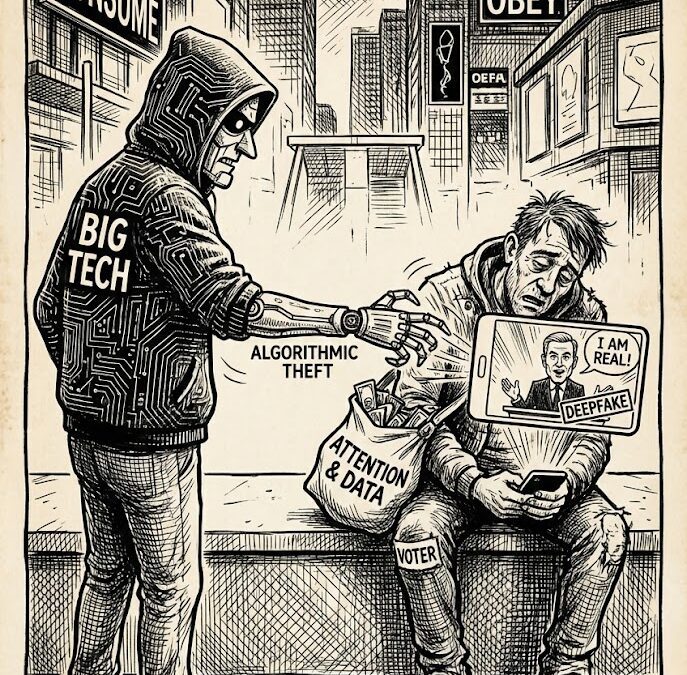
In a world where income is distributed via digital dividends and work is optional, "attention" becomes the only scarce currency. Research on digital fraud warns of a coming ecosystem of "attention fraud," where autonomous agents mimic human engagement to siphon value, and "compute theft," where the infrastructure of the basic income state is strip-mined by the very AI meant to sustain it.
We face a future of "Zero-Trust Reality." Without rigorous cryptographic "Proof of Personhood" and new forms of institutional verification, the average citizen becomes a target for automated predation. The danger is no longer that the machine will starve us, but that it will farm us—treating human attention and biometric data as resources to be harvested by capital that thinks faster than we do.
The Paradox
The paradox of the Post-Labor age is this: We are attempting to sustain a civilization that requires high-trust, high-competence maintenance, while simultaneously dismantling the very institutions that generate trust and competence.
We have spent a century trying to save humans from labor. But we forgot that labor was the only thing saving us from entropy.
The solution is not to force humans back into useless toil, but to fundamentally redefine "work" not as a market commodity, but as a civic survival mechanism. We must fund "Capability Endowments"—paying humans to maintain the skills that keep the lights on—not because it is profitable, but because it is the insurance premium for our own survival.
Perhaps the true end of labor is not economic, but existential. When the machine stops, who among us will remember how to start it?
This essay is part of the research foundation for The Theory of Recursive Displacement — a unified framework examining how AI-driven automation reshapes labor markets, capital flows, governance structures, and human economic agency. Read the full theory for the complete analysis.
Ask questions about this content?
I'm here to help clarify anything