
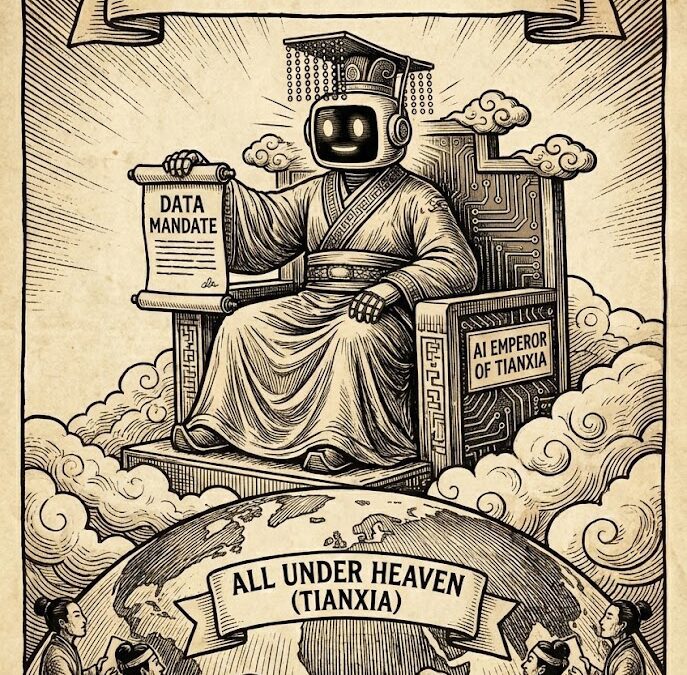
From Static Distribution to Homeostatic Social Control Consider the concept of resource allocation.
By Tyler Maddox
Executive Abstract
Current state distribution models—welfare, UBI, energy subsidies—operate as open-loop systems: policy is set, resources are distributed, and outcomes are measured months or years later. This lag creates volatility, forcing what I’ve termed the Put-Option State to underwrite expensive bailouts when social stability collapses.
The integration of real-time data with algorithmic triage closes this loop. It creates a homeostatic control system that does not merely punish rule-breakers but preemptively throttles resources—energy, compute, liquidity, mobility—to high-entropy populations to maintain system stability. This shifts the mechanism of power from judicial enforcement (punishing crime) to actuarial preemption (preventing the probability of disruption).
This is not speculation. It is the operating philosophy of China’s social credit infrastructure, and that philosophy has a name: tianxia—”all under heaven.” What Western analysts mistake for authoritarian overreach is actually the first working prototype of a governance architecture that algorithmic systems naturally converge toward. The terrifying insight is not that China invented it. The terrifying insight is that the algorithm rediscovers it independently through optimization.
Part I: The Philosophy—Tianxia and the Logic of “No Outside”
Before examining the mechanism, we must understand the worldview that makes it coherent. In classical Chinese political thought, tianxia (天下, literally “all under heaven”) represented something foreign to Western political theory: a conception of legitimate authority that claimed moral jurisdiction over everyone, not through conquest, but through the gravitational pull of civilizational virtue.
The Zhou dynasty institutionalized tianxia around the figure of the “Son of Heaven” (天子, tianzi), whose authority flowed from the Mandate of Heaven (天命, tianming). But this was not divine right in the Western sense. It was conditional authority: the ruler maintained legitimacy only so long as the realm remained harmonious. Natural disasters, social unrest, and economic collapse were interpreted as signs that the mandate had been withdrawn—that heaven itself had revoked access.
The key innovation of tianxia was its treatment of boundaries. Western political theory since Westphalia has been organized around the concept of sovereignty—distinct political units with clear borders, recognizing each other as equals. Tianxia rejects this entirely. There is no “outside.” The term for this is wuwai (无外): “no externality.” The world is a single, unified system with the virtuous center at its core, and everyone else arranged in concentric circles of diminishing proximity to that center.
“The idea of tianxia has neither an ‘inside’ nor ‘outside,’ but defines an all-inclusiveness joined together by the rule of the Son of Heaven… The family—rather than the individual—is the smallest political unit, with tianxia as the largest.”
Those who accepted this order were treated as part of a civilized, favored center. Those outside it were not “foreign”—a concept that requires recognized boundaries—but peripheral: needing to be pacified, transformed, or constrained until they could be incorporated. The famous slogan captures it: “Allow the trustworthy to roam everywhere under heaven while making it hard for the discredited to take a single step.“
This is not a metaphor. It is the explicit design philosophy of China’s social credit system. And it maps perfectly onto the architecture of digital platforms.
Part II: The Prototype—China’s Social Credit as Beta Test
Western analysts have consistently misunderstood China’s Social Credit System (SCS) by viewing it through the lens of Orwellian surveillance—an all-seeing eye that tracks and punishes. This framing misses the point. The system is not primarily about watching; it is about governing through resource access.
The SCS aggregates data from financial records, criminal records, government registries, e-commerce behavior, social media interactions, and video surveillance. But data collection is not the innovation. The innovation is what the data is used for: to determine who can access what, when, and where.
The Architecture of Access
Consider what happens to someone flagged as “discredited” in the system. They are not arrested. They are not fined. Their access is throttled:
- Mobility: Denied booking on flights and high-speed trains. As of 2019, millions had been blocked from purchasing air tickets.
- Financial: Reduced access to credit, higher interest rates, exclusion from premium financial products.
- Social: Children denied admission to private schools. Public shaming through blacklists.
- Economic: Ineligibility for government jobs, denial of business licenses and permits.
- Civic: Restricted access to public services, queuing priority degraded.
Notice what this is not: it is not punishment in the judicial sense. There is no trial, no specific crime, no proportional sentence. It is infrastructural exclusion—the gradual revocation of the ability to participate in modern life. The system does not need to imprison you. It simply makes existence progressively harder until you either conform or become effectively invisible.
The Meritown SCS—a “national model” studied by Stanford researchers—gives every adult a social credit score tied to their national ID, starting at 1,000 points. The system scores people using 389 rules: 124 reward good behavior, 265 punish bad. Those rated D face police monitoring. 66% of offenses already fall under established laws; others expand authority into “moral and social domains beyond the law.”
The Tianxia Mapping
The structural parallel to tianxia is exact:
- No Outside (Wuwai): The system is designed to be total. There is no “exit” from social credit because there is no parallel economy, no cash alternative, no off-grid existence that remains functional in a modern Chinese city. Your national ID is the key to everything. This is the digital fulfillment of tianxia’s “no externality” principle.
- Concentric Circles of Inclusion: High scorers receive benefits: tax breaks, expedited services, better loan terms. Low scorers are pushed to the periphery. This mirrors the classical tianxia hierarchy—the virtuous center enjoying full participation, the periphery constrained until it can be “civilized.”
- Conditional Mandate: Just as the Son of Heaven’s authority was contingent on maintaining harmony, the citizen’s access is contingent on maintaining “trustworthiness.” The mandate can be revoked. Heaven—now the algorithm—decides.
- Moral Authority Over Legal Authority: The 389 rules include offenses that are not illegal—they are merely “uncivilized.” Jaywalking. Reservation no-shows. Playing too many video games. Online comments. The system governs through virtue-signaling, not law.
Chinese citizens surveyed about the SCS show “high levels of approval,” particularly among educated urban populations. This is not Stockholm syndrome. It is the cultural coherence of tianxia: the system makes sense within a worldview where the state’s role is to cultivate virtue and maintain harmony, not to protect individual rights against collective authority.
Part III: The Mechanism—From Open-Loop to Closed-Loop
Now we can describe the technical evolution with precision. Current Western welfare states operate as open-loop systems:
Policy → Distribution → Outcomes (measured later, adjusted slowly)
The lag between distribution and measurement creates volatility. By the time policymakers realize a program isn’t working—or that social instability is rising—the problem has already metastasized. The Put-Option State exists precisely to underwrite these failures: bailouts, emergency interventions, riot police.
The Triage Loop closes this gap. It transforms distribution into a closed-loop homeostatic system:
Real-time social metrics → Algorithmic triage adjustment → Resource allocation → Behavior modification → Measured outcomes → Loop repeats
In cybernetic terms, this is a thermostat for social stability. The system has a “set point” (order) and uses feedback loops to correct deviations (disorder). When sensors detect rising “social entropy”—correlated spending patterns, unusual mobility, sentiment spikes on social media—the algorithm doesn’t wait for a riot. It preemptively load-sheds the affected population.
The Components
1. The Sensors (Input)
Real-time feeds from CBDC wallets (velocity of money), smart meters (energy spikes), platform sentiment analysis, mobility data from phones and transit systems, purchase patterns from e-commerce. These detect “heat”—volatility—before it becomes a fire. China’s Skynet system—400 million surveillance cameras with facial recognition—is the physical layer. Digital footprints are the informational layer.
2. The Comparator (The “Stability Index”)
The algorithm compares current social entropy against the “maintainable baseline.” This is where actuarial logic replaces judicial logic. The system doesn’t ask “Did this person commit a crime?” It asks “What is the probability that this population segment will destabilize the system?” Risk scores, not guilt verdicts.
3. The Actuators (Digital Revocation)
The mechanisms of enforcement are no longer men with guns, but code with execute permissions. Smart contracts that fail to clear. Turnstiles that don’t open. Charging stations that throttle. Accounts that freeze. The genius is that none of this requires explicit orders from a human bureaucrat. The system self-enforces through API calls.
4. Homeostasis
The system returns to stability not because the population is happy, but because it lacks the resources to be chaotic. Dissent requires energy—literal energy (electricity, fuel, food) and figurative energy (communication networks, organizational bandwidth, financial liquidity). Throttle these, and disorder becomes thermodynamically impossible.
The Dystopian Mechanism in Detail
Let me make this concrete. Imagine the sequence:
- System detects “status crime” indicators in a specific zip code—unusual clustering, elevated transaction velocity, message volume spikes correlated with known protest keywords.
- Algorithms preemptively reduce compute/energy allocations to affected populations. EV charging capped. CBDC holdings given geographic locks or expiration dates. Message reach throttled (shadowbanned) not because of content, but because of virality velocity.
- Restricted resources limit ability to organize, communicate, escalate. You cannot plan a protest if you cannot get to the location, cannot message your co-organizers, cannot access funds to buy supplies.
- Social stability metrics improve, reinforcing the algorithm’s behavior.
- System learns: repression works, optimization continues.
This is not punishment in any traditional sense. It is load-shedding. Just as a smart grid remotely disconnects AC units during peak demand to prevent a blackout, the Triage Loop reduces the “agency voltage” of specific populations during peak social stress.
Part IV: The Fracture—From Punishment to Throttling
Traditional governance is judicial: you commit a crime, you are arrested, you face trial, you receive a proportional sentence. This is expensive and reactive. It requires evidence, due process, human judgment.
The Triage Loop is technical: you display patterns correlated with high social entropy, and your capacity to act is throttled. No trial. No specific crime. No proportional sentence. The system doesn’t need to prove you did anything wrong. It just needs to predict that your type is likely to cause problems.
Antoinette Rouvroy calls this “Algorithmic Governmentality.” The system does not care about you as a subject or your political motivations. It views you as a “dividual“—a collection of data points (location, spending, energy usage, social graph) that represents a probability of risk. The goal is to “prevent the actualization of certain potentialities.”
If the system predicts a 78% chance of civil unrest in a specific zip code, it does not need to send police. It simply tightens the caloric and energetic belt of that zip code—slowing down internet speeds, limiting transit access, delaying benefit payments—until the energy for dissent dissipates.
This represents a fundamental shift in the nature of power. Michel Foucault distinguished between sovereign power (the power to kill or let live) and disciplinary power (the power to normalize through institutions). The Triage Loop introduces a third form: actuarial power—the power to predict and preempt. It doesn’t punish the criminal or discipline the deviant. It renders the potential disruptor inert before they can act.
The UBC Connection
My earlier work on Universal Basic Compute identified digital revocation as the enforcement mechanism of the post-labor economy. The Triage Loop shows what happens when revocation becomes predictive rather than punitive:
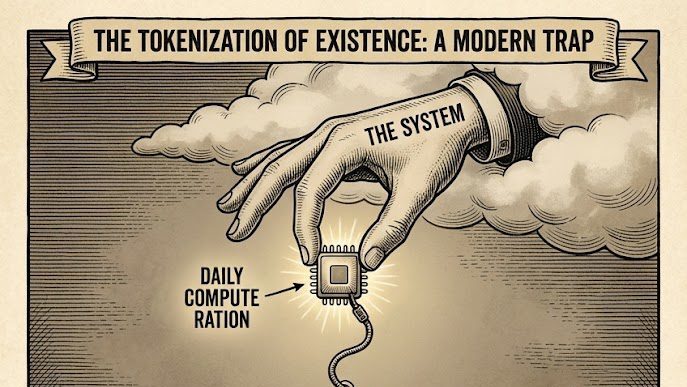
- Old model: “You broke a rule, we cut you off.”
- New model: “Our model predicts you might break a rule, we’re reducing your allocation now.”
This is Minority Report meets Walras’s auctioneer—algorithmic price discrimination for social control. The UBC trap becomes apparent: when your existence is tokenized, when every bit of your life requires compute credits, energy allocations, and platform access, then throttling is indistinguishable from exile. You don’t need to be imprisoned. You just need to be rendered unable to participate.
Part V: The Convergence—Why the Algorithm Discovers Tianxia
Here is the thesis that makes this more than an essay about China: any sufficiently optimized algorithmic governance system will converge on the tianxia architecture. The Chinese Communist Party didn’t invent this logic. They inherited it from three thousand years of political philosophy and applied it with new tools. But the tools themselves tend toward this outcome.
Consider the optimization target: minimize social volatility while minimizing enforcement cost. What does the algorithm discover?
- Totality is more efficient than boundaries: Every exit from the system is a leak in the control architecture. Cash allows anonymous transactions. Physical borders allow flight. Off-grid existence allows evasion. The optimal system has no outside. This is wuwai discovered through gradient descent.
- Graduated inclusion beats binary exclusion: Completely excluding someone is expensive and creates martyrs. Graduated throttling—concentric circles of access—keeps people invested in improving their standing while limiting their capacity for disruption. This is the tianxia hierarchy discovered through A/B testing.
- Conditional access beats unconditional rights: Rights are expensive because they cannot be revoked. Conditional access—a “mandate” that can be withdrawn—provides leverage. The system learns that contingent benefits produce more behavioral compliance than guaranteed entitlements. This is tianming discovered through behavioral economics.
- Virtue-signaling beats law enforcement: Legal systems require evidence, due process, proportionality. Moral systems require only pattern-matching. Governing through “trustworthiness” rather than “legality” expands the governance surface while reducing procedural overhead. This is Confucian virtue ethics discovered through optimization.
The West imagines that its Enlightenment values—individual rights, due process, limited government—represent an alternative to this architecture. But look at what is already being built:
- Platform moderation: Shadowbanning, reach throttling, algorithmic demotion—graduated exclusion based on behavioral patterns, not legal violations.
- Financial deplatforming: Bank accounts closed, payment processors denied, crowdfunding blocked—not for crimes, but for “reputational risk.”
- Predictive policing: Resource allocation based on algorithmic risk scores, not actual offenses.
- Dynamic pricing: Surge pricing, insurance risk premiums, credit scores—personalized access costs based on behavioral profiles.
- Benefit conditionality: Welfare tied to behavioral requirements, means-testing that functions as continuous surveillance.
Each of these is a fragment of the Triage Loop, implemented piecemeal by different actors (corporations, governments, platforms) without explicit coordination. But they are converging on the same architecture. The algorithm doesn’t need to read Confucius. It discovers the same truths through optimization.
Part VI: Early Warning Indicators
To identify when we cross the threshold from “welfare” to “control,” observe these three specific technical integrations:
Phase 1: The Identity-Wallet Merger (The Sensor)
Indicator: Financial accounts (CBDC/Bank) become inseparable from Digital ID.
The Shift: Money is no longer a bearer asset; it is a permissioned entry in a database.
Context: This destroys the “cash exit” option, forcing all economic activity into the view of the Triage Loop. Watch for CBDC rollouts that require identity verification for all transactions, elimination of cash transaction limits, and digital ID mandates for banking.
Phase 2: Dynamic vs. Entitled Benefits (The Actuator)
Indicator: Social benefits (UBI, food assistance, energy subsidies) switch from “monthly guaranteed” to “dynamically adjusted.”
The Shift: Terms like “surge pricing” or “congestion pricing” are applied to access rights.
Example: “Energy credits are reduced by 20% this week due to grid strain”—where “grid strain” is a euphemism for social unrest, or simply a pretext for behavioral management.
Phase 3: Pre-Crime Resource Revocation (The Loop)
Indicator: “Fraud detection” algorithms are expanded to include “Risk detection.”
The Shift: Accounts are frozen not because a crime occurred, but because the pattern of usage matches a theoretical risk model.
Observation: Look for “Flash Freezes”—simultaneous account lockouts of disparate individuals who share no connection other than a shared geography or behavioral pattern during a crisis.
Conclusion: The Paradox
The Triage Loop represents the final efficiency upgrade for the Put-Option State. By moving from static distribution (paying people to be quiet) to homeostatic control (incapacitating them when they get loud), the state minimizes its maintenance costs. It creates a society that is not necessarily orderly, but is incapable of disorder—a system that does not solve problems, but continuously manages the symptoms of its own decline.
The tianxia framework reveals what we’re actually building. China is not an aberration; it is a preview. The philosophy of “all under heaven” is not culturally specific; it is the natural endpoint of algorithmic governance. When you give a system the objective of maintaining stability and the tools of real-time resource allocation, it will discover tianxia on its own. No Son of Heaven required. The algorithm is the Son of Heaven.
And here is the paradox we must sit with:
The Triage Loop is both the inevitable response to the crises of late capitalism and the final foreclosure of any alternative. It is the logical conclusion of a system that cannot afford to let people fail and cannot afford to let them succeed on their own terms. It is welfare perfected into a prison. It is care that cannot let go.
The question is not whether this system will be built. Pieces of it already exist. The question is whether we can recognize it for what it is before the loop closes—before the “no outside” becomes literal, before every transaction is metered, before the algorithm learns that the most stable society is one where no one can move at all.
In classical tianxia, the mandate could be withdrawn. Heaven could revoke access to the throne. But what happens when the algorithm is heaven? Who revokes the mandate of a system that has no outside, that encompasses all under its domain, that recognizes no legitimacy but its own optimization target?
This is the question the Triage Loop poses. And we do not yet have an answer.
Sources & Further Reading
- Zhao Tingyang, All Under Heaven: The Tianxia System for a Possible World Order (UC Press, 2021)
- Liu & Rona-Tas, “Trusting by Numbers: An Analysis of a Chinese Social Credit System Governance Infrastructure” (Stanford SCCEI, 2024)
- Brussee, “China’s Social Credit Score: Untangling Myth from Reality” (MERICS, 2023)
- Rouvroy, “Algorithmic Governmentality and Prospects of Emancipation” (Réseaux, 2013)
- Zuboff, The Age of Surveillance Capitalism (PublicAffairs, 2019)
- Werbach, “Orwell That Ends Well? Social Credit as Regulation” (Illinois Law Review, 2022)
- Maddox, “The Tokenization of Existence: Why Universal Basic Compute Is a Trap” (tylermaddox.info, 2025)
- Dongsheng News, “Tianxia: All Under Heaven” (2023)
- HAU: Journal of Ethnographic Theory, “All under heaven (tianxia): Cosmological perspectives and political ontologies in pre-modern China”
This essay is part of the research foundation for The Theory of Recursive Displacement — a unified framework examining how AI-driven automation reshapes labor markets, capital flows, governance structures, and human economic agency. Read the full theory for the complete analysis.
Ask questions about this content?
I'm here to help clarify anything