
by Tyler M | Feb 27, 2026 | Post Labor Economics, AI
Bottom Line
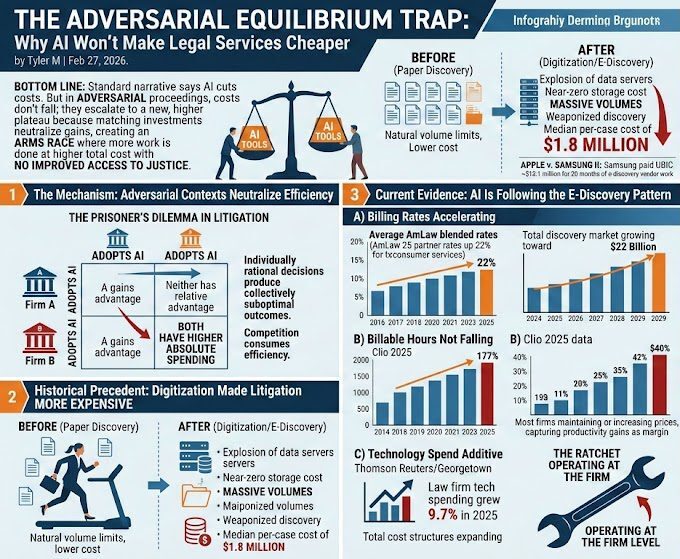
When both sides of an adversarial proceeding adopt AI, costs do not fall to a new, lower equilibrium. They escalate to a new, higher plateau. Legal services offer the cleanest empirical demonstration of this dynamic because litigation is a zero-sum game where each party’s productivity gains are immediately neutralized by the opponent’s matching investment. The result is an arms race that shifts the competitive equilibrium upward — more work gets done, more thoroughly, at higher total cost — while access to justice remains unchanged or worsens.
This finding matters for the Theory of Recursive Displacement because it challenges the most common counterargument to labor displacement: that AI will reduce costs for consumers and thus generate new demand. In adversarial contexts, the cost reduction never reaches the consumer. It is consumed by competitive escalation. Legal services are not unique in their adversarial structure — competitive business strategy, talent acquisition, marketing, cybersecurity, and regulatory compliance all exhibit the same dynamic. If the largest professional services market in the U.S. economy cannot translate AI productivity gains into consumer cost savings, the compensating demand mechanism that would rescue the Aggregate Demand Crisis thesis fails in every adversarial domain.
Confidence calibration: 55–65% that the adversarial equilibrium mechanism is producing a structural cost escalation rather than a temporary adjustment period. The e-discovery historical precedent raises confidence; the absence of direct empirical measurement of bilateral-AI litigation costs lowers it. The binding uncertainty is whether the billing structure standoff breaks before the adversarial dynamic locks in — a question the current data cannot answer definitively.
Part I: The Mechanism — Why Adversarial Contexts Neutralize Efficiency Gains
The standard productivity narrative assumes AI makes legal work cheaper, cheaper legal work reaches more people, and access to justice improves. This narrative implicitly assumes cooperative or monopolistic market structure. It fails in adversarial settings because of a structural feature: each party’s incentive is not to minimize cost but to maximize relative advantage over the opposing party.
Curl, Kapoor, and Narayanan — Justin Curl (J.D. candidate, Harvard Law School), Sayash Kapoor (Ph.D. candidate, Princeton CITP), and Arvind Narayanan (Professor of Computer Science, Princeton; CITP Director) — identify this as one of three bottlenecks preventing AI from reducing legal costs in their February 12, 2026 Lawfare paper “AI Won’t Automatically Make Legal Services Cheaper.” [Published Analysis] Their central observation: the adversarial structure of American litigation means that when both parties adopt productivity-enhancing technologies, competitive equilibria simply shift upward. The other two bottlenecks — regulatory barriers (unauthorized practice of law rules) and human involvement limits (judges and clients still make decisions at human speed) — reinforce the adversarial dynamic but are analytically distinct from it.
The game-theoretic structure is a symmetric two-player game where:
If Party A adopts AI and Party B does not, Party A gains significant advantage — asymmetric discovery, faster brief preparation, better case prediction. If Party B also adopts AI, neither gains relative advantage, but both have increased their absolute spending. If neither adopts, both save money but face risk that the other defects. The dominant strategy for both parties is to adopt, producing a Nash equilibrium at higher total cost.
This is structurally identical to the prisoner’s dilemma driving hyperscaler capex in the AI Capex War — but operating at the level of individual litigation rather than corporate infrastructure investment. Davidson Kempner Capital Management’s CIO captured the hyperscaler version: “You have to invest in it because your peers are investing in it.” Replace “invest” with “deploy AI for discovery” and “peers” with “opposing counsel” and the structure is identical. The mechanism is the same: individually rational decisions produce collectively suboptimal outcomes. What differs is the scale. The AI Capex War is a multi-player prisoner’s dilemma among a handful of hyperscalers committing hundreds of billions. The adversarial equilibrium trap is the same game played millions of times per year across every contested legal proceeding in the American judicial system.
This is worth stating precisely because the game-theoretic structure operates at three nested scales. At the firm level, each law firm must adopt AI or lose competitive position against firms that have. At the case level, each litigant must deploy AI or face asymmetric disadvantage against an opponent who has. At the infrastructure level, the hyperscalers supplying the AI tools must keep investing or lose market position to competitors who do. The Ratchet tightens at all three levels simultaneously. The nesting means that even if one level somehow broke free — say, a bilateral agreement between opposing counsel to limit AI use — the firm-level and infrastructure-level dynamics would reimpose the competitive pressure.
Part II: The E-Discovery Precedent — When Digitization Made Litigation More Expensive
The strongest evidence for the adversarial equilibrium mechanism is not prospective but historical. The digitization of discovery was supposed to reduce litigation costs by making document search faster and cheaper. It did the opposite.
Before digitization, discovery was paper-based and inherently self-limiting. Creating and storing paper is costly in both funds and physical space, imposing natural constraints on discovery scope. After digitization, the cost of electronic information generation and storage dropped to near zero, which massively expanded the volume of discoverable material. Rather than reducing costs, parties exploited the explosion of digital documents to impose greater burdens on opponents. [Measured]
The RAND Institute for Civil Justice documented this pattern in its 2012 study Where the Money Goes: Understanding Litigant Expenditures for Producing Electronic Discovery (Pace & Zakaras, MG-1208-ICJ). A critical nuance: RAND framed the cost escalation as a widely-held claim that it then investigated empirically, not as its own independent conclusion. The study examined eight large corporations across 57 large-volume cases and found median per-case ESI production costs of $1.8 million, with 73% going to document review. [Measured] An ABA survey cited within the RAND report found three-quarters of respondents agreed that discovery costs, as a share of total litigation costs, had increased disproportionately due to the advent of e-discovery. The Association of Corporate Counsel has separately stated that discovery continues to comprise up to 80% of litigation costs. [Survey Data]
The scale is staggering even without the disputed figures that circulate in vendor marketing. In Apple v. Samsung II (N.D. Cal.), Samsung paid exactly $13,100,960.35 to its e-discovery vendor UBIC for 20 months of discovery work, documented in 399 pages of vendor invoices filed with the court. [Measured — court filings] That $13.1 million covered collection, processing, and production of approximately 3.6 terabytes across 11 million documents — of which only 880,000 (8%) were actually produced to Apple. The document review costs, which typically dwarf collection and processing, are not captured in the court-filed invoices. The e-discovery market overall is projected to exceed $15 billion in 2025, growing to approximately $22 billion within five years, according to converging estimates from Research and Markets ($15.1B / $22.5B by 2029), IMARC ($15.4B), and Fortune Business Insights ($18.7B). [Projected — market research estimates]
The mechanism is clear: when discovery became cheaper per document, the rational adversarial response was not to spend less on discovery. It was to discover more documents, impose broader preservation holds on opponents, and weaponize the volume of discoverable material as a litigation tactic. The technology made each unit of discovery cheaper while making the total volume of discovery grow faster than the per-unit cost fell.
This is the Automation Treadmill dynamic described in the Theory of Recursive Displacement in its purest adversarial form. Efficiency gains were not captured as cost savings. They were reinvested as competitive escalation.
Part III: Current Evidence — AI Is Following the E-Discovery Pattern
Early data from AI adoption in legal services suggests the e-discovery pattern is repeating, not correcting.
Billing Rates Are Accelerating, Not Falling
Despite widespread AI adoption — 79% of legal professionals report using AI per the 2025 Clio Legal Trends Report (10th edition, released October 16, 2025; methodology: 1,702 U.S. legal professionals surveyed plus aggregated Clio usage data, though “use” is broadly defined with only 8% adopting “universally” and 17% “widely”) — billing rates are accelerating. [Survey Data]
Average law firm billing rates jumped 9.2% in H1 2025, according to the Wells Fargo Legal Specialty Group’s Mid-Year Survey covering 67 AmLaw 100 firms and 46 Second Hundred firms. The full-year 2025 figure later came in at 9.6% across the AmLaw 200. [Measured — industry survey]
Wolters Kluwer’s LegalVIEW Insights (Volume 2025-1, “Benchmarking Through Complexity”), based on over $200 billion in anonymized legal invoice data, provides the granular picture. AmLaw 25 blended hourly rates reached $1,027, a 7.5% increase in Q1 2025 alone. Average partner rate at AmLaw 25 firms stood at $1,349. Among timekeepers who actually increased rates, the average jump exceeded 12% in 2024 — the overall average of approximately 6% reflects the roughly 40% of timekeepers whose rates stayed flat or decreased, masking the steepness of the increase where it occurred. AmLaw 25 partner rates for consumer services work surged 22% year-over-year to $2,105 per hour — a sector-specific outlier driven by regulatory pressure and specialized talent competition, but one that illustrates how adversarial demand in specific practice areas amplifies rate escalation. [Measured — invoice data]
AI Is Not Reducing Billable Hours
The expected mechanism — AI reduces time-per-task, reducing billable hours, reducing client costs — is not materializing in aggregate.
The Best Law Firms® 2025 survey (4,852 firms, 164,000+ lawyers; operated by BL Rankings, LLC) found that 58% of firms said AI had not affected billing practices at all. Only 20% of large firms said AI had reduced billable hours for certain tasks. The most common outcome: efficiency increased without changing billable hours (36% of large firms). [Measured — industry survey]
The Clio data tells the same story from the adoption side. Among firms that have adopted AI widely, only 11% have reduced prices. Twenty-six percent have increased prices. Eight percent have added AI-specific fees. The majority — the firms that adopted AI and did nothing to pricing — are capturing productivity gains as margin, not passing them to clients. [Measured — Clio 2025 Legal Trends Report]
Technology Spend Is Additive, Not Substitutive
The Thomson Reuters Institute / Georgetown Law Center on Ethics and the Legal Profession published the 2026 Report on the State of the US Legal Market on January 7, 2026. Four figures from that report tell the cost structure story:
Law firm technology spending grew 9.7% in 2025. Knowledge management spending climbed 10.5%. Direct lawyer compensation increased 8.2%. And 90% of all legal dollars still flow through standard hourly rate arrangements, per Thomson Reuters Legal Tracker data. [Measured — Thomson Reuters/Georgetown 2026 Report]
Total cost structures are expanding, not contracting. AI is being added to existing spend, not replacing it. This is the Ratchet operating at the firm level rather than the hyperscaler level. Once firms invest in AI infrastructure, they cannot de-invest without competitive disadvantage. The Thomson Reuters report notes that firms entered 2026 with technology spend growing nearly 10% annually, creating fixed cost obligations that must be serviced regardless of demand conditions. Firms that mistook temporary peaks for permanent shifts found themselves with bloated cost structures when conditions reversed — a pattern the report compares explicitly to 2007 pre-GFC dynamics.
The Billing Standoff
The Thomson Reuters report captures the structural impasse directly. Firms are deploying technology that can accomplish in minutes what once took hours, then trying to bill for it by the hour. Corporate legal departments want their outside law firms to propose innovative billing arrangements that incorporate AI’s efficiencies. Law firms complain that clients still evaluate everything by converting it back to hourly rates. Both sides are waiting for the other to blink first.
This standoff is not incidental. It is the adversarial equilibrium in action. Firms that unilaterally reduce prices lose revenue. Clients that unilaterally demand price cuts lose access to firms investing in AI capability. The equilibrium is structural, not a failure of negotiation.
Part IV: The Red Queen Effect — Running Faster to Stay in Place
The legal market data shows Red Queen dynamics: firms must run faster merely to maintain relative position.
The most striking evidence comes from Robert J. Couture, Senior Research Fellow at Harvard Law School’s Center on the Legal Profession. In a February 2025 Insight article based on interviews with ten AmLaw 100 firms, Couture reported that none of the firms interviewed anticipate any reduction in the need for the number of practicing attorneys. [Qualitative Interview Study, n=10] This finding coexists with reports of productivity gains greater than 100 times on specific tasks — Couture cites a complaint response system that reduced associate time from 16 hours to 3–4 minutes. [Measured — single task-specific data point]
The juxtaposition is the Red Queen in action. A 100x productivity gain on a specific litigation task does not reduce headcount, because every firm’s opponents have access to the same tools. The gain is consumed by competitive escalation — more thorough discovery, more comprehensive briefing, more exhaustive case preparation — not converted into labor savings or cost reductions. The firms that captured those gains did not fire associates. They redeployed them to the next competitive frontier.
This connects directly to the Theory of Recursive Displacement’s description of the Red Queen Effect: firms must keep automating just to maintain relative position, even when absolute gains prove elusive. The legal market makes the dynamic visible because the adversarial structure eliminates the ambiguity present in cooperative markets. In a cooperative market, you can argue about whether productivity gains are being shared with consumers on a delayed timeline. In litigation, the gains are demonstrably consumed by the opponent’s matching investment. There is no consumer to share with. There are only two parties, each rationally escalating.
Part V: The Access-to-Justice Paradox
The cruelest implication of the adversarial equilibrium: AI was supposed to democratize legal services. Instead, it may widen the gap.
In the Entity Substitution essay, I documented the cost differential: a first-year associate at a top-25 law firm bills at approximately $951 per hour. AI legal research tools perform comparable work at roughly 30% of that rate. [Measured] For routine, non-adversarial work — document drafting, form completion, basic research — the cost savings are real and accessible. But in litigation, the cost savings from AI accrue to the party that already has sophisticated legal representation. When both sides have AI, the new equilibrium cost is higher than the old one. When only one side has AI, it is the resourced party that benefits — creating greater asymmetry, not less.
An ACC/Everlaw survey of 657 in-house legal professionals across 30 countries (3rd annual edition, released October 14, 2025) found that 64% of corporate legal teams expect to rely less on outside counsel as they bring AI tools in-house — up from 58% in 2024. [Survey of Expectations, n=657] Smaller clients without in-house legal departments face the same or higher costs from outside firms that are adding AI spend to their cost structures without reducing rates.
This is the bifurcation pattern identified in the Theory of Recursive Displacement operating in a new domain: sophisticated actors capture AI’s benefits while less-resourced actors face unchanged or worsened conditions. The pattern mirrors the labor market bifurcation documented in Structural Exclusion — experienced workers complemented by AI, entry-level workers displaced by it — but applied to litigants rather than workers. The well-resourced party is complemented. The under-resourced party faces a more capable opponent at no reduction in their own costs.
There is a further asymmetry the standard analysis misses. The adversarial equilibrium does not merely prevent cost reduction — it creates asymmetric cost escalation for the less-resourced party. When a well-funded corporate litigant deploys AI to generate exhaustive discovery demands, the burden falls disproportionately on the party with fewer resources to respond. AI becomes a force multiplier for existing power asymmetries — the adversarial version of the cost differential that drives Entity Substitution across every domain where institutional protections attach to entities that cannot match the cost curve.
Part VI: What This Means for the Theory of Recursive Displacement
Connection to the Automation Treadmill
The legal services adversarial equilibrium is the Automation Treadmill operating in a zero-sum environment. In cooperative markets, automation gains can theoretically be shared between producer surplus and consumer surplus. In adversarial markets, the gains are entirely consumed by competitive escalation — the treadmill runs faster, but neither side advances. The Theory describes the Treadmill as a self-reinforcing cycle where each new efficiency measure creates conditions that demand even more automation. The legal market data shows this cycle in its purest form: AI-driven efficiency in discovery compels opposing counsel to match, which raises the baseline, which compels further investment.
Connection to the Ratchet
The Ratchet mechanism — capital commitments that can only tighten and cannot reverse — operates at the firm level in legal services just as it operates at the hyperscaler level in infrastructure. The Thomson Reuters report documents law firm technology spend growing at nearly 10% annually. These are not discretionary investments. They are competitive necessities that become fixed cost obligations. A firm that reduces its AI investment loses relative position against every firm that maintains or increases theirs. The Ratchet’s logic at the hyperscaler level — where Bank of America projects 10–20% stock declines for any hyperscaler that signals capex pullback — maps directly onto law firms where clients migrate toward firms with superior AI capability and away from firms perceived as technologically lagging.
Connection to the Demand Crisis
The adversarial equilibrium finding is a direct rebuttal to the “AI will lower prices and create new demand” argument against the Aggregate Demand Crisis thesis. That thesis argues that when firms collectively reduce labor costs through AI-driven optimization, they collectively destroy the consumer demand that funds their revenue. The standard counterargument is that AI will lower costs for consumers, generating new demand that absorbs displaced workers.
The adversarial equilibrium shows this counterargument fails in every market with adversarial structure. Legal services are the clearest case, but the dynamic generalizes. In cybersecurity, every defensive AI improvement compels an offensive AI improvement by adversaries, and vice versa. In competitive intelligence, every firm’s AI-driven market analysis compels matching investment by competitors. In talent acquisition, every AI-powered recruiting tool is matched by AI-powered candidate screening, with neither side gaining net advantage. In regulatory compliance, every AI system deployed to meet regulatory requirements compels regulators to deploy AI to verify compliance, which compels regulated entities to invest further. In each domain, the adversarial structure consumes the efficiency gains that would otherwise reach consumers as lower prices.
The demand crisis does not require that AI fails to produce efficiency gains. It requires only that those gains are captured by competitive escalation rather than passed through to consumer prices. The legal services data provides the first large-scale empirical evidence that this capture mechanism is active.
Part VII: The Gap in the Evidence
Intellectual honesty requires stating what the data does not show. No empirical studies have been published that directly measure total litigation cost changes in cases where both parties use AI tools versus cases where neither does or only one does. The adversarial equilibrium thesis remains a theoretical framework supported by historical analogy (the e-discovery escalation), game-theoretic reasoning (the prisoner’s dilemma structure), and circumstantial evidence (billing rates accelerating during a period of rapid AI adoption). These are strong forms of evidence. They are not direct measurement.
The closest available academic literature includes David Freeman Engstrom and Jonah B. Gelbach’s analysis in “Legal Tech, Civil Procedure, and the Future of Adversarialism” (University of Pennsylvania Law Review, Vol. 169, 2020), which examines how legal technology tools shift cost distributions in litigation but provides no empirical cost data from bilateral AI adoption. Technology-assisted review (TAR) effectiveness studies (Grossman & Cormack, 2011) measure per-task review accuracy and efficiency improvements but do not track total litigation costs. Industry data showing that only 6% of firms pass AI savings to clients (Axiom 2025) is consistent with the thesis but does not directly test it.
The direct empirical test — matching comparable cases by type and complexity, then comparing total costs across four conditions (no AI, plaintiff-only AI, defendant-only AI, bilateral AI) — has not been conducted. This represents both the most important research gap and the strongest potential falsification opportunity. If bilateral AI cases show lower total costs than no-AI cases, the adversarial equilibrium thesis fails. The absence of this test is not an argument for the thesis. It is a limitation that should be resolved by empirical research, and I will update this analysis when such data becomes available.
Part VIII: Falsification Conditions
This mechanism should be downgraded if any of the following conditions are met:
Average litigation costs per case decline by 15% or more within three years of widespread bilateral AI adoption in comparable case types, controlling for case complexity. This would indicate that adversarial escalation is not consuming efficiency gains. The comparison must be within case type and complexity tier — a shift in case mix toward simpler matters would not constitute falsification.
The e-discovery cost pattern reverses. Total e-discovery spending declines in absolute terms despite continued growth in discoverable data volume. This would indicate that the historical precedent does not generalize to AI. Market research projections currently show continued growth ($15B to $22B within five years), so this reversal would be a significant disconfirmation.
Alternative fee arrangements — flat fees, value-based pricing — reach 50% or more of legal billing by revenue within two years, with demonstrated lower total costs to clients. The threshold is revenue-weighted, not firm-count-weighted, because the adversarial dynamics are concentrated in high-value litigation where hourly billing dominates. Note: a shift to AFAs alone does not falsify the thesis if total costs per case continue to rise. Billing structure is a proxy for cost reduction, not a direct measure of it.
Legal aid and pro bono AI tools achieve outcome parity with commercial AI tools in adversarial proceedings within three years. This would indicate that the access-to-justice gap is closing despite the adversarial equilibrium — that the democratization thesis is succeeding through a pathway the current data does not reflect.
Direct empirical measurement shows bilateral-AI cases cost less than comparable no-AI cases on a total-cost basis. This is the kill shot. If the data shows that when both sides adopt AI, total costs fall, the mechanism described in this essay is wrong and should be retracted.
Evidence Classification
| Claim | Classification |
|---|---|
| E-discovery increased costs despite reducing per-unit processing time | [Measured — RAND MG-1208, ACC, court filings] |
| Billing rates accelerating despite AI adoption | [Measured — Wells Fargo, Wolters Kluwer invoice data] |
| AI not reducing billable hours in aggregate | [Measured — Best Law Firms survey, Clio 2025] |
| Technology spend additive not substitutive | [Measured — Thomson Reuters/Georgetown 2026] |
| No AmLaw 100 firm anticipates reducing attorney headcount | [Qualitative Interview Study, n=10 — Harvard CLP] |
| 100x productivity gains on specific tasks | [Measured — single task, Harvard CLP] |
| Adversarial equilibrium shifts costs upward | [Theoretical — game theory + historical analogy, untested directly] |
| AI adoption will follow e-discovery cost pattern | [Projected — pattern match, not measured] |
| Access-to-justice gap will widen | [Projected — inferred from bifurcation dynamics] |
| 64% of corporate teams expect to reduce outside counsel reliance | [Survey of Expectations, n=657 — ACC/Everlaw 2025] |
Where This Connects
The AI Capex War documents the prisoner’s dilemma at the infrastructure level. This essay documents the same game structure at the litigation level and the firm level. The nesting of the same coordination failure across three scales — infrastructure, firm, case — is itself evidence that the dynamic is structural rather than incidental. It is not a feature of one market. It is a feature of adversarial competition under conditions of technological capability escalation.
Entity Substitution documents how the legal profession’s protections attach to licensed professionals while AI-native services bypass the licensing framework. This essay adds the finding that even where licensed professionals retain their role, the cost structure escalates rather than contracts. Entity substitution and the adversarial equilibrium are complementary mechanisms: the first erodes protections from below (cheaper unlicensed alternatives), the second inflates costs from above (bilateral AI escalation). Both operate simultaneously, squeezing the traditional legal services model from both directions.
The Wage Signal Collapse documents the demand-side destruction of the expertise pipeline. In legal services, the adversarial equilibrium adds a twist: the 100x productivity gains on specific tasks compress the visible value of junior associate work, but the Red Queen dynamic prevents firms from reducing headcount. The result is a labor market where junior lawyers are retained but their perceived value — the signal that recruits the next cohort — is degraded. The wage signal for legal careers is increasingly “you will work with AI tools doing more volume at similar rates” rather than “you will develop deep expertise that commands a premium.” Whether this produces the enrollment effects documented in the Wage Signal Collapse for computer science remains to be seen in law school application data.
The Aggregate Demand Crisis argues that AI-driven cost optimization collectively destroys the consumer demand that funds firm revenue. The adversarial equilibrium is the mechanism that prevents the standard escape from that crisis. If AI lowered costs for consumers, the new demand generated might absorb displaced workers. In adversarial markets, it does not lower costs. The demand crisis proceeds without the compensating price reduction that optimists project.
This essay was developed from a research brief compiled from the sources listed below. All empirical claims were independently verified against primary sources. Figures that could not be traced to primary institutional publications were either corrected to verified sources or excluded. The adversarial equilibrium mechanism is a theoretical framework supported by historical analogy and circumstantial evidence; it has not been directly tested empirically. The essay will be updated when direct empirical measurement becomes available.
Key Sources
- Curl, Kapoor, Narayanan (2026). “AI Won’t Automatically Make Legal Services Cheaper.” Lawfare, February 12, 2026.
- Thomson Reuters Institute / Georgetown Law (2026). “2026 Report on the State of the US Legal Market.” January 7, 2026.
- Wolters Kluwer (2025). “LegalVIEW Insights Volume 2025-1: Benchmarking Through Complexity.”
- Wells Fargo Legal Specialty Group (2025). Mid-Year 2025 Law Firm Survey.
- Clio (2025). “2025 Legal Trends Report.” 10th edition, October 16, 2025.
- Best Law Firms® / BL Rankings, LLC (2025). Survey of approximately 4,852 U.S. law firms.
- RAND Institute for Civil Justice (2012). Where the Money Goes: Understanding Litigant Expenditures for Producing Electronic Discovery. Pace & Zakaras, MG-1208-ICJ.
- Couture, Robert J. (2025). “The Impact of Artificial Intelligence on Law Firms’ Business Models.” Harvard Law School Center on the Legal Profession, February 24, 2025.
- ACC / Everlaw (2025). “GenAI Strategic Value for Corporate Law Departments.” 3rd annual edition, October 14, 2025.
- Association of Corporate Counsel. “Top Ten Tips to Combat the Hidden Costs of Discovery.”
- Engstrom, David Freeman & Jonah B. Gelbach (2020). “Legal Tech, Civil Procedure, and the Future of Adversarialism.” University of Pennsylvania Law Review, Vol. 169.
- Apple Inc. v. Samsung Electronics Co. (N.D. Cal.). UBIC vendor invoices filed with the court, 399 pages.
Ask questions about this content?
I'm here to help clarify anything